


Page 351 - Peterson 85 Years And Going Strong
P. 351
on those preliminary contracts were all headquar-
tered in the Bay Area,” says Bill Doyle, who had
been manager of Peterson’s new Chico store at
the time. “They already knew us because we had
supported them multiple times on other jobs. And
they were accustomed to our level of product sup-
port.” Sometime in 1957, Guy F. Atkinson, among
others, went to Caterpillar to request that Peterson
be given the territory—and Cat listened. In July
1958, Peterson was officially awarded the territory
formerly held by Sierra Tractor & Equipment Co.
out of Redding and Chico. Peterson’s new Chico
store was built specifically to support the dam con-
struction.
and twenty Cat 660 wheel tractors with Athey
bottom-dump wagons. In the end, the main Or-
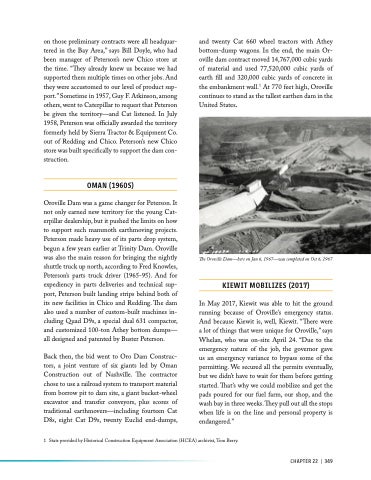
oville dam contract moved 14,767,000 cubic yards
of material and used 77,520,000 cubic yards of
earth fill and 320,000 cubic yards of concrete in
the embankment wall.1 At 770 feet high, Oroville
continues to stand as the tallest earthen dam in the
United States.
OMAN (1960S)
The Oroville Dam—here on Jan 6, 1967—was completed on Oct 6, 1967
KIEWIT MOBILIZES (2017)
Oroville Dam was a game changer for Peterson. It
not only earned new territory for the young Cat-
erpillar dealership, but it pushed the limits on how
to support such mammoth earthmoving projects.
Peterson made heavy use of its parts drop system,
begun a few years earlier at Trinity Dam. Oroville
was also the main reason for bringing the nightly
shuttle truck up north, according to Fred Knowles,
Peterson’s parts truck driver (1965-95). And for
expediency in parts deliveries and technical sup-
port, Peterson built landing strips behind both of
its new facilities in Chico and Redding. The dam
also used a number of custom-built machines in-
cluding Quad D9s, a special dual 631 compactor,
and customized 100-ton Athey bottom dumps—
all designed and patented by Buster Peterson.
Back then, the bid went to Oro Dam Construc-
tors, a joint venture of six giants led by Oman
Construction out of Nashville. The contractor
chose to use a railroad system to transport material
from borrow pit to dam site, a giant bucket-wheel
excavator and transfer conveyors, plus scores of
traditional earthmovers—including fourteen Cat
D8s, eight Cat D9s, twenty Euclid end-dumps,
In May 2017, Kiewit was able to hit the ground
running because of Oroville’s emergency status.
And because Kiewit is, well, Kiewit. “There were
a lot of things that were unique for Oroville,” says
Whelan, who was on-site April 24. “Due to the
emergency nature of the job, the governor gave
us an emergency variance to bypass some of the
permitting. We secured all the permits eventually,
but we didn’t have to wait for them before getting
started. That’s why we could mobilize and get the
pads poured for our fuel farm, our shop, and the
wash bay in three weeks. They pull out all the stops
when life is on the line and personal property is
endangered.”
1 Stats provided by Historical Construction Equipment Association (HCEA) archivist, Tom Berry.
CHAPTER 22 | 349


