


Page 297 - Peterson 85 Years And Going Strong
P. 297
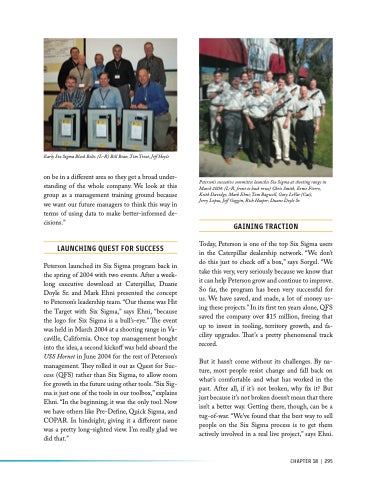
Early Six Sigma Black Belts: (L-R) Bill Bean, Tim Treat, Jeff Hoyle
on be in a different area so they get a broad under-
standing of the whole company. We look at this
group as a management training ground because
we want our future managers to think this way in
terms of using data to make better-informed de-
cisions.”
LAUNCHING QUEST FOR SUCCESS
Peterson launched its Six Sigma program back in
the spring of 2004 with two events. After a week-
long executive download at Caterpillar, Duane
Doyle Sr. and Mark Ehni presented the concept
to Peterson’s leadership team. “Our theme was Hit
the Target with Six Sigma,” says Ehni, “because
the logo for Six Sigma is a bull’s-eye.” The event
was held in March 2004 at a shooting range in Va-
caville, California. Once top management bought
into the idea, a second kickoff was held aboard the
USS Hornet in June 2004 for the rest of Peterson’s
management. They rolled it out as Quest for Suc-
cess (QFS) rather than Six Sigma, to allow room
for growth in the future using other tools. “Six Sig-
ma is just one of the tools in our toolbox,” explains
Ehni. “In the beginning, it was the only tool. Now
we have others like Pre-Define, Quick Sigma, and
COPAR. In hindsight, giving it a different name
was a pretty long-sighted view. I’m really glad we
did that.”
Peterson’s executive committee launches Six Sigma at shooting range in
March 2004: (L-R, front to back rows) Chris Smith, Ernie Fierro,
Keith Davidge, Mark Ehni; Tom Bagwell, Gary LeVar (Cat),
Jerry Lopus, Jeff Goggin, Rich Hasper; Duane Doyle Sr.
GAINING TRACTION
Today, Peterson is one of the top Six Sigma users
in the Caterpillar dealership network. “We don’t
do this just to check off a box,” says Sorgel. “We
take this very, very seriously because we know that
it can help Peterson grow and continue to improve.
So far, the program has been very successful for
us. We have saved, and made, a lot of money us-
ing these projects.” In its first ten years alone, QFS
saved the company over $15 million, freeing that
up to invest in tooling, territory growth, and fa-
cility upgrades. That’s a pretty phenomenal track
record.
But it hasn’t come without its challenges. By na-
ture, most people resist change and fall back on
what’s comfortable and what has worked in the
past. After all, if it’s not broken, why fix it? But
just because it’s not broken doesn’t mean that there
isn’t a better way. Getting there, though, can be a
tug-of-war. “We’ve found that the best way to sell
people on the Six Sigma process is to get them
actively involved in a real live project,” says Ehni.
CHAPTER 18 | 295


