


Page 298 - Peterson 85 Years And Going Strong
P. 298
SIX SIGMA PROJECTS
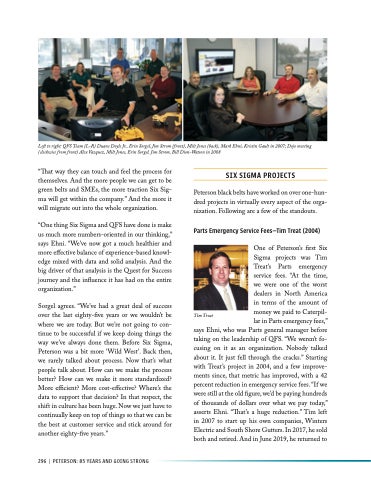
Left to right: QFS Team (L-R) Duane Doyle Jr., Erin Sorgel, Jim Strom (front), Milt Jones (back), Mark Ehni, Kristin Gault in 2007; Dojo meeting
(clockwise from front) Alex Vazquez, Milt Jones, Erin Sorgel, Jim Strom, Bill Dion-Watson in 2008
“That way they can touch and feel the process for
themselves. And the more people we can get to be
green belts and SMEs, the more traction Six Sig-
ma will get within the company.” And the more it
will migrate out into the whole organization.
“One thing Six Sigma and QFS have done is make
us much more numbers-oriented in our thinking,”
says Ehni. “We’ve now got a much healthier and
more effective balance of experience-based knowl-
edge mixed with data and solid analysis. And the
big driver of that analysis is the Quest for Success
journey and the influence it has had on the entire
organization.”
Sorgel agrees. “We’ve had a great deal of success
over the last eighty-five years or we wouldn’t be
where we are today. But we’re not going to con-
tinue to be successful if we keep doing things the
way we’ve always done them. Before Six Sigma,
Peterson was a bit more ‘Wild West’. Back then,
we rarely talked about process. Now that’s what
people talk about. How can we make the process
better? How can we make it more standardized?
More efficient? More cost-effective? Where’s the
data to support that decision? In that respect, the
shift in culture has been huge. Now we just have to
continually keep on top of things so that we can be
the best at customer service and stick around for
another eighty-five years.”
Peterson black belts have worked on over one-hun-
dred projects in virtually every aspect of the orga-
nization. Following are a few of the standouts.
Parts Emergency Service Fees—Tim Treat (2004)
One of Peterson’s first Six
Sigma projects was Tim
Treat’s Parts emergency
service fees. “At the time,
we were one of the worst
dealers in North America
in terms of the amount of
Tim Treat
money we paid to Caterpil-
lar in Parts emergency fees,”
says Ehni, who was Parts general manager before
taking on the leadership of QFS. “We weren’t fo-
cusing on it as an organization. Nobody talked
about it. It just fell through the cracks.” Starting
with Treat’s project in 2004, and a few improve-
ments since, that metric has improved, with a 42
percent reduction in emergency service fees. “If we
were still at the old figure, we’d be paying hundreds
of thousands of dollars over what we pay today,”
asserts Ehni. “That’s a huge reduction.” Tim left
in 2007 to start up his own companies, Winters
Electric and South Shore Gutters. In 2017, he sold
both and retired. And in June 2019, he returned to
296 | PETERSON: 85 YEARS AND GOING STRONG


