


Page 299 - Peterson 85 Years And Going Strong
P. 299
Peterson, back to his roots as a project manager at
Power, working on the global account data center
team.
Shop Supplies and Small Tools: Bill Bean (2004)
Bill Bean’s 2004 project fo-
cused on streamlining the
purchase of shop supplies
and small tools to a list of
vendors that could actually
fit on one page. “Back then,
the cost to generate one
vendor P.O. was $41.81 be-
Bill Bean
cause of all the manpower
involved. We centralized a lot of those purchases
to Caterpillar and got that figure down to $7.43,”
explains Bean, current VP and GM of Peterson
Machinery. “We were doing a P.O. for every-
thing. We might have an auto parts store deliver a
four-dollar filter, but because of the cost of gener-
ating a P.O., our actual cost was forty-one dollars
on top of the cost of the filter. That was part of
what led us to buy almost everything from Cat.”
Bean’s team came up with a primary vendor list
(Caterpillar), and a secondary list of discounted
alternatives. In the end, they were able to cut the
transaction cost by 82 percent, which has saved
Peterson a boatload of money every year since.
“Six Sigma taught me to keep digging,” says Bean.
“And if something doesn’t look right, I can’t let it
go until I check it out, which has worked well for
me in a lot of different situations.”
Reman Cores: Danny Fong (2005)
Danny Fong’s 2005 reman
core project is still one of
Peterson’s most successful
projects to date. One of the
metrics under scrutiny was
the turnaround time be-
tween when Peterson first
issued a core credit to a cus-
Danny Fong
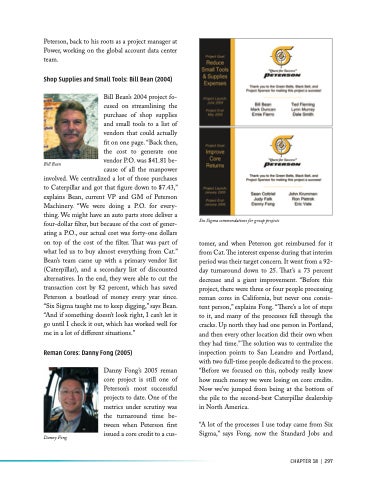
Six Sigma commendations for group projects
tomer, and when Peterson got reimbursed for it
from Cat. The interest expense during that interim
period was their target concern. It went from a 92-
day turnaround down to 25. That’s a 73 percent
decrease and a giant improvement. “Before this
project, there were three or four people processing
reman cores in California, but never one consis-
tent person,” explains Fong. “There’s a lot of steps
to it, and many of the processes fell through the
cracks. Up north they had one person in Portland,
and then every other location did their own when
they had time.” The solution was to centralize the
inspection points to San Leandro and Portland,
with two full-time people dedicated to the process.
“Before we focused on this, nobody really knew
how much money we were losing on core credits.
Now we’ve jumped from being at the bottom of
the pile to the second-best Caterpillar dealership
in North America.
“A lot of the processes I use today came from Six
Sigma,” says Fong, now the Standard Jobs and
CHAPTER 18 | 297


