


Page 391 - Peterson 85 Years And Going Strong
P. 391
by themselves, so we’ve been using dozers to assist
in loading even back to the first DW10 pull-scrap-
ers.” As scrapers got bigger, the need for more
pushing power became more critical. “Scrapers just
kept getting bigger and bigger and bigger,” says
Krieg, a veteran operator of forty-five years who
also helped develop Cat’s H and M series motor
graders. “The ‘51s and ‘57s and then the 660s and
triple 6s—those scrapers were just too big for one
D9 to push, so you had to use two.2 And that took
synchronization. If the two operators didn’t work
exactly the same way, the synchronization would
get screwed up.”
In 1961, Buster patented his cushion push block
and push dozer concept. It was the same year Cat-
erpillar debuted its 385 hp D9G. “Before that,
people used an S dozer or U dozer blade on their
push-Cat,” explains Duane Sr. “Those blades artic-
ulated and could puncture an expensive tire or dig
into the side of the scraper cut. Buster’s cushion
dozer design solved both those problems. It cush-
ioned the impact of the two tractors and channeled
all that power along the axis line, which reduced
wear and tear on both machines.”
Once Buster’s Quads gained traction in the in-
dustry, Cat started building their own machines
(designated MAO or machines as ordered) be-
ginning in 1965, still using the 66A serial number
prefix. The first set used serial numbers 66A2903
and 2904. Quads were found all across the United
States, from Buster’s original ten and Caterpillar’s
thirty-five early 66A sets3 to the fifty-one DD9G
and seven DD9H sets Cat produced from 1968 to
1980.
“The great thing about the Quad was that it was
already hooked together,” says Krieg, who saw his
first one in 1970 while working on I-5 in Wash-
ington State just south of the Stanwood Cutoff.
The great thing about the Quad
was that it was already hooked together.
You didn’t have to wait for the second unit
to catch up. The second you made contact
with the scraper, you had the full power of
both units.
– Randy Krieg, former Quad operator
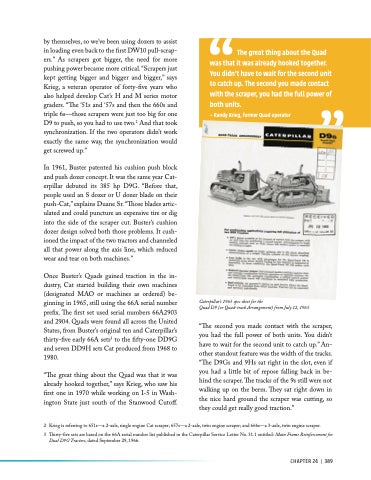
Caterpillar’s 1965 spec sheet for the
Quad D9 (or Quad-track Arrangement) from July 12, 1965
“The second you made contact with the scraper,
you had the full power of both units. You didn’t
have to wait for the second unit to catch up.” An-
other standout feature was the width of the tracks.
“The D9Gs and 9Hs sat right in the slot, even if
you had a little bit of repose falling back in be-
hind the scraper. The tracks of the 9s still were not
walking up on the berm. They sat right down in
the nice hard ground the scraper was cutting, so
they could get really good traction.”
2 Krieg is referring to 651s—a 2-axle, single engine Cat scraper; 657s—a 2-axle, twin engine scraper; and 666s—a 3-axle, twin engine scraper.
3 Thirty-five sets are based on the 66A serial number list published in the Caterpillar Service Letter No. 31.1 entitled: Main Frame Reinforcement for
Dual D9G Tractors, dated September 29, 1966.
CHAPTER 24 | 389


