


Page 390 - Peterson 85 Years And Going Strong
P. 390
rear unit were added by Alaska Unlimited [second
owner] because the hard nose had started to crack.
You could also see the gauges that Wilder’s [third
owner] master mechanic put on the hardnose of
the rear unit. Those were all still there.”
Back home, Krieg did more research and con-
firmed that Peterson’s restored Quads were the real
deal, although not a Buster original. “When I took
pictures of them at Peterson’s picnic, I zoomed in
on both serial numbers: 90J079 and 91J079. And
those matched Caterpillar’s records for Quad-
Tracks built in 1969. That year they built eight sets
with serial numbers #78 to #85.”
Peter Kiewit & Sons bought Quad No.79 some-
time in 1969 and shipped it to Alaska in 1970,
along with a second set. Krieg suspects that the
other set could be an original Buster Peterson
Quad, but there is no proof positive, and the set
was subsequently split up and parted-out. Peterson
records do show that Peter Kiewit & Sons owned
three Peterson-built Quads in the mid-1960s—
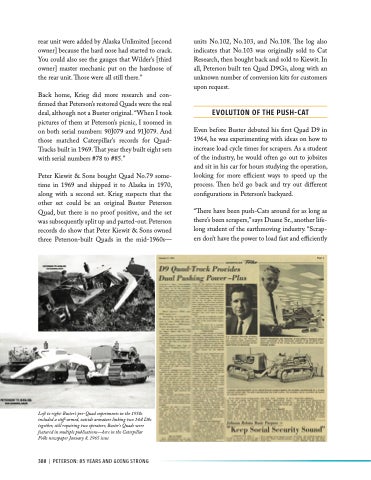
Left to right: Buster’s pre-Quad experiments in the 1950s
included a stiff-armed, outside armature linking two 14A D8s
together, still requiring two operators; Buster’s Quads were
featured in multiple publications—here in the Caterpillar
Folks newspaper January 8, 1965 issue
388 | PETERSON: 85 YEARS AND GOING STRONG
units No.102, No.103, and No.108. The log also
indicates that No.103 was originally sold to Cat
Research, then bought back and sold to Kiewit. In
all, Peterson built ten Quad D9Gs, along with an
unknown number of conversion kits for customers
upon request.
EVOLUTION OF THE PUSH-CAT
Even before Buster debuted his first Quad D9 in
1964, he was experimenting with ideas on how to
increase load cycle times for scrapers. As a student
of the industry, he would often go out to jobsites
and sit in his car for hours studying the operation,
looking for more efficient ways to speed up the
process. Then he’d go back and try out different
configurations in Peterson’s backyard.
“There have been push-Cats around for as long as
there’s been scrapers,” says Duane Sr., another life-
long student of the earthmoving industry. “Scrap-
ers don’t have the power to load fast and efficiently


