


Page 244 - Peterson 85 Years And Going Strong
P. 244
a lot of questions. I went to classes and got edu-
cated. And then I started filling out applications
for the Carl Moyer Program grant. Gary Galindo
from Peterson walked me through the whole ap-
plication process. He’s the one that reached out to
us and let us know what was coming. He shared
what he was hearing from everyone else’s ordeals
and downfalls, and that made things easier.”
What Bryan hadn’t counted on was having to redo
the application process for all his trucks. Multi-
ple times. “I spent two weeks of twelve-hour days
getting all the paperwork done. Then I’d find out
that the filter CARB had approved was no lon-
ger valid and I’d have to start all over again.” In
the end, PJ’s was awarded $285,000 in Carl Moyer
funds to retrofit seven trucks with DPF filters and
repower an eighth. But the sixty-forty split would
still take a big bite out of the company’s pocket.
“Adding those filters wasn’t going to fix the prob-
lem. It was just going to buy us some time so we
If it’s not out on the road, we’re
losing money.
–Bill Bryan, fleet manager, PJ’s Rebar Inc.
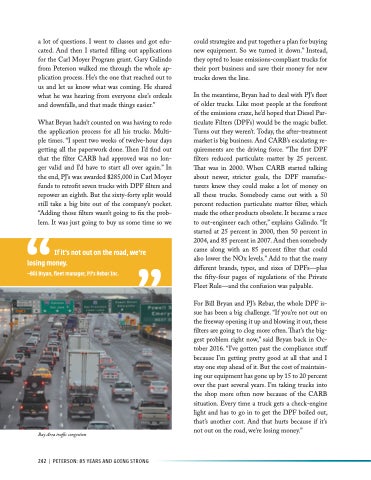
Bay Area traffic congestion
242 | PETERSON: 85 YEARS AND GOING STRONG
could strategize and put together a plan for buying
new equipment. So we turned it down.” Instead,
they opted to lease emissions-compliant trucks for
their port business and save their money for new
trucks down the line.
In the meantime, Bryan had to deal with PJ’s fleet
of older trucks. Like most people at the forefront
of the emissions craze, he’d hoped that Diesel Par-
ticulate Filters (DPFs) would be the magic bullet.
Turns out they weren’t. Today, the after-treatment
market is big business. And CARB’s escalating re-
quirements are the driving force. “The first DPF
filters reduced particulate matter by 25 percent.
That was in 2000. When CARB started talking
about newer, stricter goals, the DPF manufac-
turers knew they could make a lot of money on
all these trucks. Somebody came out with a 50
percent reduction particulate matter filter, which
made the other products obsolete. It became a race
to out-engineer each other,” explains Galindo. “It
started at 25 percent in 2000, then 50 percent in
2004, and 85 percent in 2007. And then somebody
came along with an 85 percent filter that could
also lower the NOx levels.” Add to that the many
different brands, types, and sizes of DPFs—plus
the fifty-four pages of regulations of the Private
Fleet Rule—and the confusion was palpable.
For Bill Bryan and PJ’s Rebar, the whole DPF is-
sue has been a big challenge. “If you’re not out on
the freeway opening it up and blowing it out, these
filters are going to clog more often. That’s the big-
gest problem right now,” said Bryan back in Oc-
tober 2016. “I’ve gotten past the compliance stuff
because I’m getting pretty good at all that and I
stay one step ahead of it. But the cost of maintain-
ing our equipment has gone up by 15 to 20 percent
over the past several years. I’m taking trucks into
the shop more often now because of the CARB
situation. Every time a truck gets a check-engine
light and has to go in to get the DPF boiled out,
that’s another cost. And that hurts because if it’s
not out on the road, we’re losing money.”


