


Page 246 - Peterson 85 Years And Going Strong
P. 246
THE LAST STRAW FOR CATERPILLAR
CARB’s 2010 ruling of an 85 percent carbon emissions
reduction plus a lower NOx level finally pushed Caterpillar
over the edge. “When they reached 85 percent reduction, the
next thing CARB wanted to address was NOx levels,” explains
Galindo. “Ironically, reducing particulate matter actually
boosts NOx levels. So the next goal from the EPA was to
lower the NOx levels while keeping PM at 85 percent.” That’s
where Caterpillar drew the line—choosing to not build a 2010
emissions-compliant product. That’s when they exited the
on-highway engine business altogether.
EMISSIONS REGULATIONS AND
COMMERCIAL ENGINES
Providing power is a core service that goes back to
Peterson’s founding in 1936. But sixty years later,
the EPA’s diesel emissions mandates changed the
rules for the entire industry. From EPG and in-
dustrial engines to trucking and marine, Peterson
customers have all felt the bite of CARB’s man-
dates. The emissions regulations have affected ev-
ery combustion engine in California.
On the industrial side of the house, commer-
cial engines like standby generators, ag pumps,
air compressors, and chippers all require annual
permits, much like DMV registration for auto-
mobiles. Thousands of standby generators in Pe-
terson’s territory cost roughly $1,400 per unit per
year for a use permit, paid to their local air-quality
district. But with the changing emissions land-
scape, commercial engine owners were staring
at major changes. California developed the Carl
Moyer program to incentivize owners to make
those changes. However, for the Electric Power
Generation (EPG) standby market—which com-
prises the vast majority of Peterson’s commercial
engine business—the incentive programs haven’t
been much help. “It just doesn’t make sense to
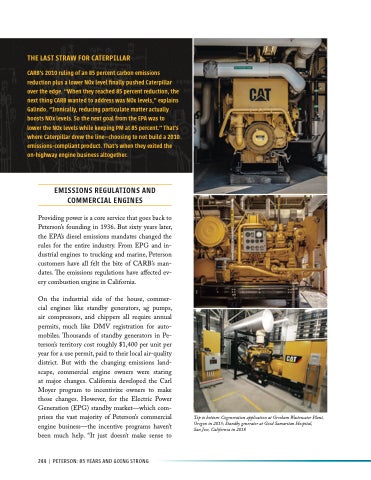
Top to bottom: Cogeneration application at Gresham Wastewater Plant,
Oregon in 2015; Standby generator at Good Samaritan Hospital,
San Jose, California in 2018
244 | PETERSON: 85 YEARS AND GOING STRONG


