


Page 98 - Peterson 85 Years And Going Strong
P. 98
CORE VALUE: CUSTOMER FIRST
Caterpillar was, indeed, busy building a strategic alliance with York International. They’d been watching the
worldwide rental market—big contenders like Aggreko, G.E., Allston, and Sunbelt. All were full-service
rental enterprises who offered generators, compressors, and temperature control. Cat realized that to compete
they had to rent more than just generators.
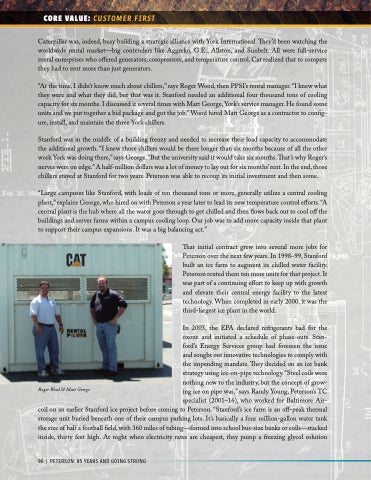
“At the time, I didn’t know much about chillers,” says Roger Wood, then PPSI’s rental manager. “I knew what
they were and what they did, but that was it. Stanford needed an additional four thousand tons of cooling
capacity for six months. I discussed it several times with Matt George, York’s service manager. He found some
units and we put together a bid package and got the job.” Wood hired Matt George as a contractor to config-
ure, install, and maintain the three York chillers.
Stanford was in the middle of a building frenzy and needed to increase their load capacity to accommodate
the additional growth. “I knew those chillers would be there longer than six months because of all the other
work York was doing there,” says George. “But the university said it would take six months. That’s why Roger’s
nerves were on edge.” A half-million dollars was a lot of money to lay out for six months’ rent. In the end, those
chillers stayed at Stanford for two years. Peterson was able to recoup its initial investment and then some.
“Large campuses like Stanford, with loads of ten thousand tons or more, generally utilize a central cooling
plant,” explains George, who hired on with Peterson a year later to lead its new temperature control efforts. “A
central plant is the hub where all the water goes through to get chilled and then flows back out to cool off the
buildings and server farms within a campus cooling loop. Our job was to add more capacity inside that plant
to support their campus expansions. It was a big balancing act.”
That initial contract grew into several more jobs for
Peterson over the next few years. In 1998–99, Stanford
built an ice farm to augment its chilled water facility.
Peterson rented them ten more units for that project. It
was part of a continuing effort to keep up with growth
and elevate their central energy facility to the latest
technology. When completed in early 2000, it was the
third-largest ice plant in the world.
In 2003, the EPA declared refrigerants bad for the
ozone and initiated a schedule of phase-outs. Stan-
ford’s Energy Services group had foreseen the issue
and sought out innovative technologies to comply with
the impending mandate. They decided on an ice bank
strategy using ice-on-pipe technology. “Steel coils were
nothing new to the industry, but the concept of grow-
Roger Wood & Matt George
ing ice on pipe was,” says Randy Young, Peterson’s TC
specialist (2001–16), who worked for Baltimore Air-
coil on an earlier Stanford ice project before coming to Peterson. “Stanford’s ice farm is an off-peak thermal
storage unit buried beneath one of their campus parking lots. It’s basically a four million-gallon water tank
the size of half a football field, with 360 miles of tubing—formed into school bus-size banks or coils—stacked
inside, thirty feet high. At night when electricity rates are cheapest, they pump a freezing glycol solution
96 | PETERSON: 85 YEARS AND GOING STRONG


