


Page 91 - Peterson 85 Years And Going Strong
P. 91
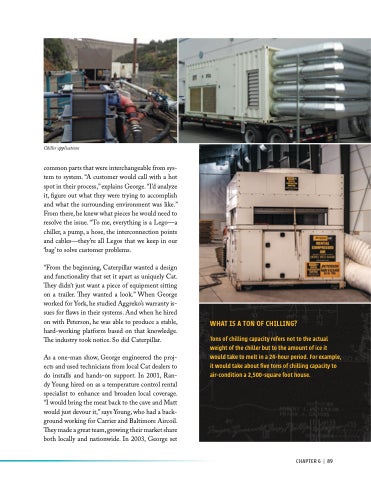
Chiller applications
common parts that were interchangeable from sys-
tem to system. “A customer would call with a hot
spot in their process,” explains George. “I’d analyze
it, figure out what they were trying to accomplish
and what the surrounding environment was like.”
From there, he knew what pieces he would need to
resolve the issue. “To me, everything is a Lego—a
chiller, a pump, a hose, the interconnection points
and cables—they’re all Legos that we keep in our
‘bag’ to solve customer problems.
“From the beginning, Caterpillar wanted a design
and functionality that set it apart as uniquely Cat.
They didn’t just want a piece of equipment sitting
on a trailer. They wanted a look.” When George
worked for York, he studied Aggreko’s warranty is-
sues for flaws in their systems. And when he hired
on with Peterson, he was able to produce a stable,
hard-working platform based on that knowledge.
The industry took notice. So did Caterpillar.
As a one-man show, George engineered the proj-
ects and used technicians from local Cat dealers to
do installs and hands-on support. In 2001, Ran-
dy Young hired on as a temperature control rental
specialist to enhance and broaden local coverage.
“I would bring the meat back to the cave and Matt
would just devour it,” says Young, who had a back-
ground working for Carrier and Baltimore Aircoil.
They made a great team, growing their market share
both locally and nationwide. In 2003, George set
WHAT IS A TON OF CHILLING?
Tons of chilling capacity refers not to the actual
weight of the chiller but to the amount of ice it
would take to melt in a 24-hour period. For example,
it would take about five tons of chilling capacity to
air-condition a 2,500-square foot house.
CHAPTER 6 | 89


