


Page 89 - Peterson 85 Years And Going Strong
P. 89
site in case of a power failure. And all those gen-
erators need to be serviced and maintained. Every
time we go out to do a service or take a customer’s
piece of equipment off-line for repair, a rental gen-
erator goes along to back it up. We support our
service department on basically every project they
do to eliminate any risk to the customer.”
Peterson’s Rental Power group functions in two
modes: known events during regular business
hours and middle-of-the-night emergencies. Sixty
percent of the time, rental generators go out on
a standby basis as backup for scheduled mainte-
nance or repairs. And sometimes they’re providing
prime power during planned events for customers
who run their entire building project with Peter-
son mobile power modules. The other 40 percent
are emergencies—like when a transformer blows,
half the city is out, and the local public utility calls.
“Those middle-of-the-night calls are when we
have to be ready to act on a moment’s notice,” says
Schalk. “We usually have equipment rolling out
of the yard within the hour. It’s a team effort that
takes a lot of coordination. And we’re good at it.”
Those middle-of-the-night calls
are when we have to be ready to act on a
moment’s notice. We usually have equipment
rolling out of the yard within the hour.
–  George Schalk, rental general manager,
Peterson Power Systems
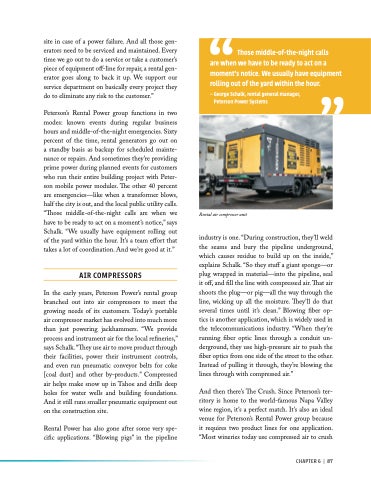
Rental air compressor unit
AIR COMPRESSORS
In the early years, Peterson Power’s rental group
branched out into air compressors to meet the
growing needs of its customers. Today’s portable
air compressor market has evolved into much more
than just powering jackhammers. “We provide
process and instrument air for the local refineries,”
says Schalk. “They use air to move product through
their facilities, power their instrument controls,
and even run pneumatic conveyor belts for coke
[coal dust] and other by-products.” Compressed
air helps make snow up in Tahoe and drills deep
holes for water wells and building foundations.
And it still runs smaller pneumatic equipment out
on the construction site.
Rental Power has also gone after some very spe-
cific applications. “Blowing pigs” in the pipeline
industry is one. “During construction, they’ll weld
the seams and bury the pipeline underground,
which causes residue to build up on the inside,”
explains Schalk. “So they stuff a giant sponge—or
plug wrapped in material—into the pipeline, seal
it off, and fill the line with compressed air. That air
shoots the plug—or pig—all the way through the
line, wicking up all the moisture. They’ll do that
several times until it’s clean.” Blowing fiber op-
tics is another application, which is widely used in
the telecommunications industry. “When they’re
running fiber optic lines through a conduit un-
derground, they use high-pressure air to push the
fiber optics from one side of the street to the other.
Instead of pulling it through, they’re blowing the
lines through with compressed air.”
And then there’s The Crush. Since Peterson’s ter-
ritory is home to the world-famous Napa Valley
wine region, it’s a perfect match. It’s also an ideal
venue for Peterson’s Rental Power group because
it requires two product lines for one application.
“Most wineries today use compressed air to crush
CHAPTER 6 | 87


