


Page 58 - Peterson 85 Years And Going Strong
P. 58
had still been in there. We really shouldn’t have
been using a forklift because that’s not a real safe
piece of equipment. It could drop without the guy
even doing anything. An overhead crane would
have been better. What I learned was: never put
yourself in the way of kinetic energy—or stored
energy—because if it moves or drops, you get in-
jured. I was young enough, I probably didn’t think
much about it. Years later, I’m thinking: Wow, I
could have lost a bunch of fingers.”
We cannot be an excellent
company if we’re not excellent in safety.
We pride ourselves on being a family business
and truly caring for people. That’s why we are
committed to safety now more than ever.
It’s a never-ending journey to always get
better, which is part of our DNA.
–  Duane Doyle Jr., president of Peterson Tractor,
Peterson-Cat
Senior learned another valuable lesson on the
Warm Springs Dam project in the late 70s. “One
story Vern Renwick [veteran field mechanic]
drilled into us on the dam was about 657 scrapers.
In the early days of the 657s and large scrapers, the
wheels would crack due to fatigue or bad metal-
lurgy. Those big wheels were held together with a
huge row of bolts holding the planetary final drive
in place. If someone was working on it and didn’t
know the wheel was cracked, once they loosened
the last bolt, the air pressure in the tire would blow
that whole wheel assembly off. And, the mechanic
with it because they weighed several tons. We saw
pictures of one blown 100 yards away. Thankfully it
never happened to us on the dam. We learned from
other people’s experiences and mistakes. There’s all
kinds of ways to get hurt in this industry.”
Peterson’s safety journey has come a long way since
then. When Tyler Dougall and Malerie Carr came
56 | PETERSON: 85 YEARS AND GOING STRONG
to Peterson in 2003, they
began building on the
foundation their prede-
cessor and mentor, Mike
Gillen, had established.
Building relationships
was key. “I needed peo-
ple. I needed their help
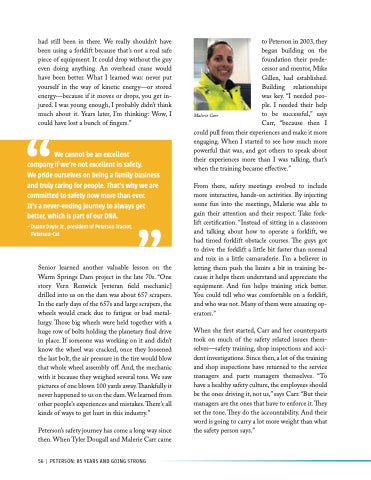
Malerie Carr
to be successful,” says
Carr, “because then I
could pull from their experiences and make it more
engaging. When I started to see how much more
powerful that was, and got others to speak about
their experiences more than I was talking, that’s
when the training became effective.”
From there, safety meetings evolved to include
more interactive, hands-on activities. By injecting
some fun into the meetings, Malerie was able to
gain their attention and their respect. Take fork-
lift certification. “Instead of sitting in a classroom
and talking about how to operate a forklift, we
had timed forklift obstacle courses. The guys got
to drive the forklift a little bit faster than normal
and mix in a little camaraderie. I’m a believer in
letting them push the limits a bit in training be-
cause it helps them understand and appreciate the
equipment. And fun helps training stick better.
You could tell who was comfortable on a forklift,
and who was not. Many of them were amazing op-
erators.”
When she first started, Carr and her counterparts
took on much of the safety related issues them-
selves—safety training, shop inspections and acci-
dent investigations. Since then, a lot of the training
and shop inspections have returned to the service
managers and parts managers themselves. “To
have a healthy safety culture, the employees should
be the ones driving it, not us,” says Carr. “But their
managers are the ones that have to enforce it. They
set the tone. They do the accountability. And their
word is going to carry a lot more weight than what
the safety person says.”


