


Page 423 - Peterson 85 Years And Going Strong
P. 423
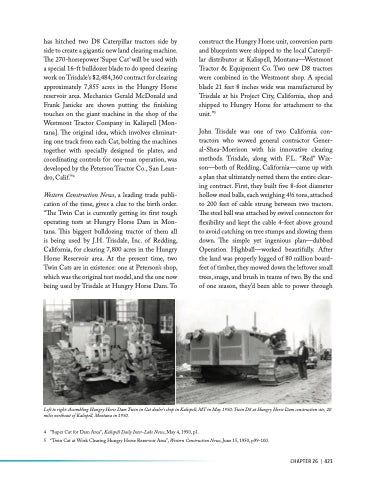
has hitched two D8 Caterpillar tractors side by
side to create a gigantic new land clearing machine.
The 270-horsepower ‘Super Cat’ will be used with
a special 16-ft bulldozer blade to do speed clearing
work on Trisdale’s $2,484,360 contract for clearing
approximately 7,855 acres in the Hungry Horse
reservoir area. Mechanics Gerald McDonald and
Frank Janicke are shown putting the finishing
touches on the giant machine in the shop of the
Westmont Tractor Company in Kalispell [Mon-
tana]. The original idea, which involves eliminat-
ing one track from each Cat, bolting the machines
together with specially designed tie plates, and
coordinating controls for one-man operation, was
developed by the Peterson Tractor Co., San Lean-
dro, Calif.”4
Western Construction News, a leading trade publi-
cation of the time, gives a clue to the birth order.
“The Twin Cat is currently getting its first tough
operating tests at Hungry Horse Dam in Mon-
tana. This biggest bulldozing tractor of them all
is being used by J.H. Trisdale, Inc. of Redding,
California, for clearing 7,800 acres in the Hungry
Horse Reservoir area. At the present time, two
Twin Cats are in existence: one at Peterson’s shop,
which was the original test model, and the one now
being used by Trisdale at Hungry Horse Dam. To
construct the Hungry Horse unit, conversion parts
and blueprints were shipped to the local Caterpil-
lar distributor at Kalispell, Montana—Westmont
Tractor & Equipment Co. Two new D8 tractors
were combined in the Westmont shop. A special
blade 21 feet 8 inches wide was manufactured by
Trisdale at his Project City, California, shop and
shipped to Hungry Horse for attachment to the
unit.”5
John Trisdale was one of two California con-
tractors who wowed general contractor Gener-
al-Shea-Morrison with his innovative clearing
methods. Trisdale, along with F.L. “Red” Wix-
son—both of Redding, California—came up with
a plan that ultimately netted them the entire clear-
ing contract. First, they built five 8-foot diameter
hollow steel balls, each weighing 4½ tons, attached
to 200 feet of cable strung between two tractors.
The steel ball was attached by swivel connectors for
flexibility and kept the cable 4-feet above ground
to avoid catching on tree stumps and slowing them
down. The simple yet ingenious plan—dubbed
Operation Highball—worked beautifully. After
the land was properly logged of 80 million board-
feet of timber, they mowed down the leftover small
trees, snags, and brush in teams of two. By the end
of one season, they’d been able to power through
Left to right: Assembling Hungry Horse Dam Twin in Cat dealer’s shop in Kalispell, MT in May 1950; Twin D8 at Hungry Horse Dam construction site, 20
miles northeast of Kalispell, Montana in 1950.
4 “Super Cat for Dam Area”, Kalispell Daily Inter-Lake News, May 4, 1950, p1.
5 “Twin Cat at Work Clearing Hungry Horse Reservoir Area”, Western Construction News, June 15, 1950, p99-100.
CHAPTER 26 | 421


