


Page 416 - Peterson 85 Years And Going Strong
P. 416
Glen Ghilotti handled all the transportation
during the build and to the different venues the
Retro Twin was invited to. “The original Siamese
Twins were designed to split in half for shipment.
And when they arrived at their destination, you
had to bolt them back together again. Today, you
can get permits in California to transport up to
14-feet wide without much trouble,” says Ghilotti,
“so we built our Twin so all you need to do is take
the dozer blade off. Then you can ship it together
all in one piece.”
“As far as I know, no one up to that point had de-
signed a true equalizer bar yet. Not even Cat,” says
Spencer. “But this equalizer bar allows one frame
to come up over a rock or hill, but not the whole
machine. Just like any new dozer, the track frames
move independently from each other. The track
frame pivots, letting the machine stay more level
and stable so you get more traction on the ground.
And it’s way easier on the operator.”
THE DRAWINGS
THE BIG UPGRADE: EQUALIZER BAR
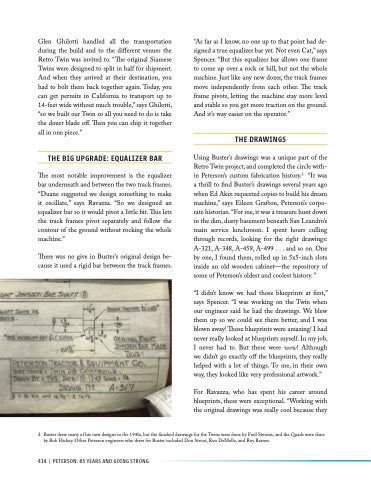
The most notable improvement is the equalizer
bar underneath and between the two track frames.
“Duane suggested we design something to make
it oscillate,” says Ravazza. “So we designed an
equalizer bar so it would pivot a little bit. This lets
the track frames pivot separately and follow the
contour of the ground without rocking the whole
machine.”
There was no give in Buster’s original design be-
cause it used a rigid bar between the track frames.
Using Buster’s drawings was a unique part of the
Retro Twin project, and completed the circle with-
in Peterson’s custom fabrication history.2 “It was
a thrill to find Buster’s drawings several years ago
when Ed Akin requested copies to build his dream
machine,” says Eileen Grafton, Peterson’s corpo-
rate historian. “For me, it was a treasure hunt down
in the dim, dusty basement beneath San Leandro’s
main service lunchroom. I spent hours culling
through records, looking for the right drawings:
A-321, A-348, A-459, A-499 . . . and so on. One
by one, I found them, rolled up in 5x5-inch slots
inside an old wooden cabinet—the repository of
some of Peterson’s oldest and coolest history. ”
“I didn’t know we had those blueprints at first,”
says Spencer. “I was working on the Twin when
our engineer said he had the drawings. We blew
them up so we could see them better, and I was
blown away! Those blueprints were amazing! I had
never really looked at blueprints myself. In my job,
I never had to. But these were wow! Although
we didn’t go exactly off the blueprints, they really
helped with a lot of things. To me, in their own
way, they looked like very professional artwork.”
For Ravazza, who has spent his career around
blueprints, these were exceptional. “Working with
the original drawings was really cool because they
2 Buster drew many of his own designs in the 1940s, but the finished drawings for the Twins were done by Fred Stevens, and the Quads were done
by Bob Hickey. Other Peterson engineers who drew for Buster included Don Stroot, Ron DeMello, and Roy Barnes.
414 | PETERSON: 85 YEARS AND GOING STRONG


