


Page 414 - Peterson 85 Years And Going Strong
P. 414
The transmissions were the ultimate test of skill
and patience on the entire Twin project—certainly
the most frustrating. Once the two transmissions
were rebuilt and ready to install, Robbins found
that one just wouldn’t fit. “The midrange 2U trans-
missions were different than later models. Two of
the shafts were a quarter-inch closer together than
on later models. When it wouldn’t go in, I pulled
that one back out and started measuring. And the
center line on two of the shafts was a quarter-inch
different. The transmissions were identical, but the
cases were wrong.” Robbins ended up driving back
up to Akin’s boneyard and rummaging around un-
til he found one that measured correctly.
They had considered line-boring the case to make
it fit but finally opted for the less risky Plan B—
starting all over again. “We disassembled a good
This was a very detailed project and
we couldn’t have done it without Phil. He had
the knowledge and experience and passion for
working on the older stuff because he worked
out of Willits for years.
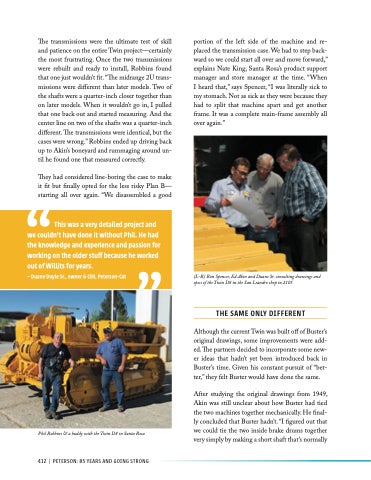
– Duane Doyle Sr., owner & CEO, Peterson-Cat Phil Robbins & a buddy with the Twin D8 in Santa Rosa
412 | PETERSON: 85 YEARS AND GOING STRONG
portion of the left side of the machine and re-
placed the transmission case. We had to step back-
ward so we could start all over and move forward,”
explains Nate King, Santa Rosa’s product support
manager and store manager at the time. “When
I heard that,” says Spencer, “I was literally sick to
my stomach. Not as sick as they were because they
had to split that machine apart and get another
frame. It was a complete main-frame assembly all
over again.”
(L-R) Ron Spencer, Ed Akin and Duane Sr. consulting drawings and
specs of the Twin D8 in the San Leandro shop in 2105
THE SAME ONLY DIFFERENT
Although the current Twin was built off of Buster’s
original drawings, some improvements were add-
ed. The partners decided to incorporate some new-
er ideas that hadn’t yet been introduced back in
Buster’s time. Given his constant pursuit of “bet-
ter,” they felt Buster would have done the same.
After studying the original drawings from 1949,
Akin was still unclear about how Buster had tied
the two machines together mechanically. He final-
ly concluded that Buster hadn’t. “I figured out that
we could tie the two inside brake drums together
very simply by making a short shaft that’s normally


