


Page 399 - Peterson 85 Years And Going Strong
P. 399
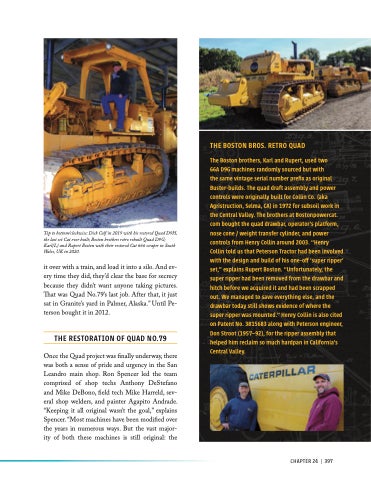
Top to bottom/clockwise: Dick Colf in 2019 with his restored Quad D9H,
the last set Cat ever built; Boston brothers retro rebuilt Quad D9G;
Karl(L) and Rupert Boston with their restored Cat 666 scraper in South
Wales, UK in 2020.
it over with a train, and load it into a silo. And ev-
ery time they did, they’d clear the base for secrecy
because they didn’t want anyone taking pictures.
That was Quad No.79’s last job. After that, it just
sat in Granite’s yard in Palmer, Alaska.” Until Pe-
terson bought it in 2012.
THE RESTORATION OF QUAD NO.79
Once the Quad project was finally underway, there
was both a sense of pride and urgency in the San
Leandro main shop. Ron Spencer led the team
comprised of shop techs Anthony DeStefano
and Mike DeBono, field tech Mike Harreld, sev-
eral shop welders, and painter Agapito Andrade.
“Keeping it all original wasn’t the goal,” explains
Spencer. “Most machines have been modified over
the years in numerous ways. But the vast major-
ity of both these machines is still original: the
THE BOSTON BROS. RETRO QUAD
The Boston brothers, Karl and Rupert, used two
66A D9G machines randomly sourced but with
the same vintage serial number prefix as original
Buster-builds. The quad draft assembly and power
controls were originally built for Collin Co. (aka
Agristruction, Selma, CA) in 1972 for subsoil work in
the Central Valley. The brothers at Bostonpowercat.
com bought the quad drawbar, operator’s platform,
nose cone / weight transfer cylinder, and power
controls from Henry Collin around 2003. “Henry
Collin told us that Peterson Tractor had been involved
with the design and build of his one-off ‘super ripper’
set,” explains Rupert Boston. “Unfortunately, the
super ripper had been removed from the drawbar and
hitch before we acquired it and had been scrapped
out. We managed to save everything else, and the
drawbar today still shows evidence of where the
super ripper was mounted.” Henry Collin is also cited
on Patent No. 3815683 along with Peterson engineer,
Don Stroot (1957–92), for the ripper assembly that
helped him reclaim so much hardpan in California’s
Central Valley.
CHAPTER 24 | 397


