


Page 397 - Peterson 85 Years And Going Strong
P. 397
Washington on Hwy 395. It was a ten-million-
yard job, and we used them there quite a bit.
“Anybody who’s been around Quads knows that
you could sink the can of a scraper down into the
ground fourteen to sixteen inches—as far as you
want to bury it—and if it’s loose material, the dirt
just boils over. A single Cat—be it a D9L or a 10N
or 10R or 10T—there’s just no comparison. The
Quad has much more power. We still like them
better, although we don’t use them anymore. If
you’ve got a very big, long area, they’ll out-perform
single machines. But nowadays, you just don’t see
that large of a dirt project much.”
Dick Colf in Woodland, WA, owns the last
DD9H set Caterpillar ever built, a vintage 1979
model—S/N 97V194 and 98V194. Colf ’s career
spans forty-seven years with Kiewit, from project
engineer to executive vice president. “From 1979
to 1995, we put twelve thousand hours on that
Quad. Its first job was on SR-520, extending the
highway from Bellevue to Redmond. I bought it
from Kiewit in 2000 and only did minor main-
tenance, and then painted it since it was in very
good condition. Kiewit owned five Quads in the
Northwest and I have the fifth set. The other four
were all DD9Gs.”
Kiewit used Quads to push-load scrapers on a
number of large earthmoving jobs in the late
1960s and ’70s. “The first job I was on was in 1967
pushing 651s outside Arlington, Oregon along the
Columbia River,” says Colf. “Kiewit was relocat-
ing a portion of the Union Pacific railroad, and I
was an engineer keeping track of how many loads
we were getting per hour. We also used Quads to
build a section of the highway upriver from John
Day Dam. We were borrowing coarse gravel near
the river and then building embankments up to
one hundred feet high to raise the highway. Kiew-
it had quite a few of those jobs. And they used a
double D9 on them. We were getting sixty loads
an hour, which meant you were only pushing for
twenty-five seconds.”
EXISTING QUADS
The search continues for existing Buster-built Quads
and Cat-built Quads. Current known data listed below:
Peterson-Cat (California) owns one Quad D9G
•
90J79 & 91J79: 1969 Cat-built, bought from
Granite (AK) in 2012
Kiewit (Nebraska) sold three Quad D9Gs in 1973
•
66A2600 & 66A2621: 1964 Buster-built No.108,
last known location: Oregon
•
90J64 & 91J64: 1968 Cat-built, current owner:
Scarsella Bros. (Washington)
•
90J85 & 91J85: 1969 Cat-built, last known
location: Wyoming
Scarsella Bros. (Washington) owns four Quad D9Gs
•
66A3806 & 66A3808: 1966 Cat-built, June 1, 1970
•
90J64 & 91J64: 1968 Cat-built, Feb 1, 1986
•
90J68 & 90J69: 1968 Cat-built, March 29, 1990
•
90J103 & 91J103: 1972 Cat-built, May 1, 1986
Coppage Construction (Kentucky) owns one Quad D9G
•
66A3907 & 66A3908: 1966 Cat-built, bought 1972,
Possible first owner: SJ Groves
Dick Colf—Retired Kiewit executive (Washington) owns
one Quad D9H, bought from Kiewit in 2000
•
97V194 & 98V194: 1979 Cat-built
Anaconda 13 (Arizona) originally used at Twin Buttes
Mine—66A D9Gs (5 of the 13 found at Empire-Cat)
•
66A4686 & 66A4687: 1966, delivered Feb. 4, 1966
•
66A4001 & 66A4002: 1966, delivered March 9, 1966
•
66A4108 & 66A4109: 1966, delivered March 9, 1966
•
66A4671 & 66A4672: 1966, delivered Dec. 10, 1966
•
66A4691 & 66A4692: 1966, delivered Dec. 10, 1966
Bostonpowercat.com (United Kingdom)
Retro-Rebuild 2017—Quad D9G
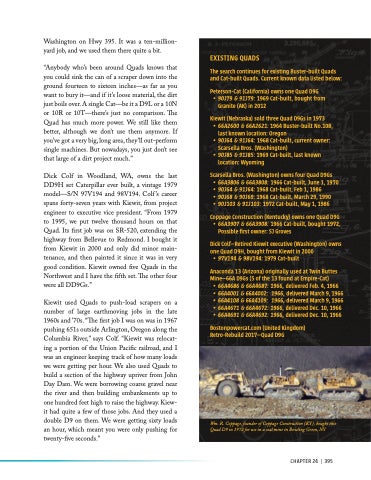
Wm. R. Coppage, founder of Coppage Construction (KY), bought this
Quad D9 in 1972 for use in a coal mine in Bowling Green, NY
CHAPTER 24 | 395


