


Page 337 - Peterson 85 Years And Going Strong
P. 337
experienced what we had out on the ice.” In Feb-
ruary 2014, a bid proposal went out for nine new
Challenger tractors customized for the extreme
cold. They wanted the first one ready to fly out of
McChord AFB (Tacoma, WA) in September so
they could test it alongside the original machines
on the 2014-2015 Traverse season. The other eight
were due by mid-December for shipment from
Port Hueneme, near Los Angeles, in mid-January
for the once-a-year voyage to Antarctica.
Peterson and three other Caterpillar dealers were
invited to bid. “We were up against the Austra-
lia-Tasmanian dealer who had done the first set of
Challengers,” says Duane Jr. “We didn’t have any
blueprints to work off of, just some pictures and
verbal descriptions.” What Peterson did have was
Craig Bolton. He knew from experience what the
Traverse tractors looked like and where their de-
ficiencies were. He’d also worked on the Traverse
with Tim Thomas and knew him well. “No one at
Peterson knew what a Traverse tractor was or what
it had to do,” says Bolton. “They knew absolutely
nothing about it. But everyone involved was 110
percent open to my ideas and suggestions. They
needed someone to tell them what needed to be
done. So all those times out on the trail when I’d
thought This needs to be different and Why wasn’t
it done this way—I was able to put all those ideas
down on paper and we just ran with it.”
Peterson won the bid in March 2014 and start-
ed gearing up. It stipulated nine rubber-tracked
MT 865C Challengers with 525-hp Cat engines.
At the time, AGCO-Challenger was just switch-
ing over to the Swedish-built Tier 4 SISU engine,
which uses urea (DEF) to meet emissions com-
pliance. Ironically, emissions issues are the exact
opposite in the polar regions because urea freezes.
Randy Grimes, Peterson’s Ag GM, was quick to
snag the last nine Challengers off the assembly line
with Cat C18 engines in them. “We didn’t have a
P.O. yet, but they were slated for us,” says Joe Frati,
the project manager who converted Portland’s old
weld shop into a new dedicated Challenger Shop.
“By the time we had the shop organized and or-
dered the parts we thought we’d need, the tractors
were starting to show up.” It was finally go time.
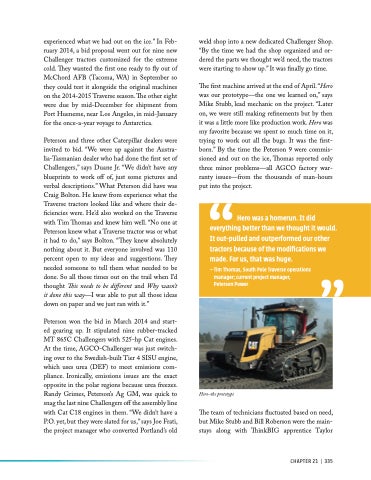
The first machine arrived at the end of April. “Hero
was our prototype—the one we learned on,” says
Mike Stubb, lead mechanic on the project. “Later
on, we were still making refinements but by then
it was a little more like production work. Hero was
my favorite because we spent so much time on it,
trying to work out all the bugs. It was the first-
born.” By the time the Peterson 9 were commis-
sioned and out on the ice, Thomas reported only
three minor problems—all AGCO factory war-
ranty issues—from the thousands of man-hours
put into the project.
Hero was a homerun. It did
everything better than we thought it would.
It out-pulled and outperformed our other
tractors because of the modifications we
made. For us, that was huge.
–  Tim Thomas, South Pole Traverse operations
manager; current project manager,
Peterson Power
Hero–the prototype
The team of technicians fluctuated based on need,
but Mike Stubb and Bill Roberson were the main-
stays along with ThinkBIG apprentice Taylor
CHAPTER 21 | 335


