


Page 33 - Peterson 85 Years And Going Strong
P. 33
values, having good communication, and knowing
how to treat our customers and each other,” ex-
plains Duane Sr. “How we treat each other and our
customers is what defines how well we’re going to
do as a company. That’s our competitive edge.”
CATALYST FOR CHANGE
Today, Peterson is a big company trying to act
like a small company, according to Duane Doyle
Jr., president of the earthmoving division, and
Peterson’s fourth-generation heir apparent. Over
the past eighty-five years, Peterson has assimilat-
ed fifteen different companies into its fold. Each
has brought a different culture with it. The last
twenty-five years alone have seen major changes in
Peterson’s makeup, with the acquisition of Cresco
(1997), Papé-Cat (2003), SITECH (2009), Hal-
ton-Cat (2010), Bayshore International (2011),
BuildingPoint Pacific (2015), and Brattain In-
ternational Trucks (2018). The influx of new em-
ployees, product diversity, and the sheer volume of
business have demanded a new platform of unity
in order to succeed.
“The last two Cat dealer acquisitions [Papé and
Halton] were very large and had very different cul-
tures from our own,” says Erin Sorgel, Peterson’s
CFO. “It was apparent from the beginning that
we needed to find a common language in order to
serve our customers well. We needed a baseline to
be able to say, ‘This is how we’re going to conduct
ourselves. This is how we’re going to do business to
succeed’. Brand Ambassador is part of the founda-
tion for that.” It is the driving force behind Peter-
son’s culture change.
The other catalyst was the strategy work done in
2009–2011, which laid out Peterson’s values and
vision. The challenge then became how to teach
these values. How do we embed them? How do we
make sure people understand what they mean and
how to use them on a daily basis? That’s a big part
of what Brand Ambassador does. “Brand Ambas-
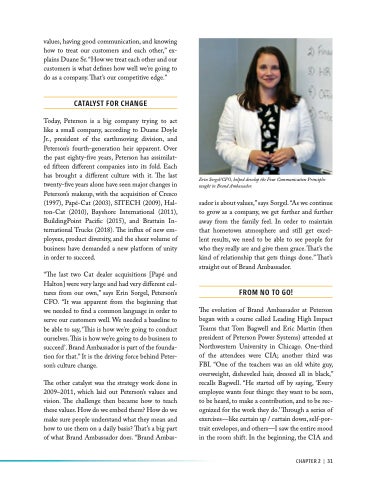
Erin Sorgel/CFO, helped develop the Four Communication Principles
taught in Brand Ambassador.
sador is about values,” says Sorgel. “As we continue
to grow as a company, we get further and further
away from the family feel. In order to maintain
that hometown atmosphere and still get excel-
lent results, we need to be able to see people for
who they really are and give them grace. That’s the
kind of relationship that gets things done.” That’s
straight out of Brand Ambassador.
FROM NO TO GO!
The evolution of Brand Ambassador at Peterson
began with a course called Leading High Impact
Teams that Tom Bagwell and Eric Martin (then
president of Peterson Power Systems) attended at
Northwestern University in Chicago. One-third
of the attendees were CIA; another third was
FBI. “One of the teachers was an old white guy,
overweight, disheveled hair, dressed all in black,”
recalls Bagwell. “He started off by saying, ‘Every
employee wants four things: they want to be seen,
to be heard, to make a contribution, and to be rec-
ognized for the work they do.’ Through a series of
exercises—like curtain up / curtain down, self-por-
trait envelopes, and others—I saw the entire mood
in the room shift. In the beginning, the CIA and
CHAPTER 2 | 31


