


Page 327 - Peterson 85 Years And Going Strong
P. 327
on work. You’re not trying to balance both aspects
at the same time like at a normal college. And each
semester you come back [to Peterson], you get a
little more advanced and roll into heavier jobs.”
Nate King is also a big proponent of the ThinkBIG
program. He was Jake Hughes’ boss, a few rungs
up, as product support manager in Santa Rosa
from 2015 to 2019. “I can’t think of a better way
to hire or recruit talent. I like ThinkBIG because
you get to hire people and try them out over a pe-
riod of time.” King hired six ThinkBIG graduates
in the four years he was at the Santa Rosa store.
Half his shop staff came out of the program. “I’m
actually interviewing ThinkBIG candidates today,”
said King back in July 2017. “I only have one slot
open and I don’t exactly have enough work here,
but I’ve also got five field techs retiring over the
next few years, and I can’t wait around for them to
leave before I start hiring.” That’s exactly the kind
of proactive, visionary mindset that finds and fills
Peterson’s shops with top-notch talent.
King’s philosophy does not include the job-shad-
owing approach many others use at Peterson, yet
he gets consistent results. “I treat ThinkBIG techs
the same way I would anyone who’s been here fif-
teen years. I just give them simpler tasks. I don’t
give them engine rebuilds or overly complicated
troubleshooting to do by themselves. I give them
cutting edge jobs or changing out parts that are
obviously broken. Or undercarriage repairs and
cylinder jobs. As they start to get more comfort-
able and confident—and more educated—we start
branching them out into more complex repairs. To
me, if the goal is to get a technician to be able to
complete a job by himself, as is expected of any
journeyman, then that’s what we’re going to do.
Not half a job, assisted by another journeyman. If
it takes him a bit longer to complete a job, I just
write it off to training because that’s exactly what
it is. The point is to let them trip a little bit but not
fall on their face. Let them figure it out. That’s the
best way to learn.”
REPLACING THE BABY BOOMERS
Cat dealers are still in a battle against natural at-
trition, a shrinking talent pool, and a stereotypical
bias against the skilled trades. “Our biggest chal-
lenge to the skills gap is demand versus available
talent,” says Fleming. “Student numbers are still
going down. Demand for skilled labor is going up.
And attrition of the older labor force is on a steady
rise with the baby-boomer generation.
Yet there is hope. Randy Shelton, Peterson’s cur-
rent talent acquisition manager, visits high schools
and colleges regularly and is starting to see a shift
in attitude. “There are teachers and administrators
who wholeheartedly understand the value of cre-
ating or adding to their school’s career and tech-
nical education programs. Schools without trade
programs are starting to implement them, and
those that already have them are looking to ex-
pand. Today, there are four high schools in Salem,
Oregon that are adding diesel to their automotive
programs due to industry demand and student in-
terest. Teachers and counselors are even starting to
talk up programs like ThinkBIG to their students
instead of automatically pushing all kids onto the
four-year college path. Attitudes are definitely be-
ginning to change.” That’s a big win for students
who just don’t fit the college mold. And a big relief
for Peterson and the rest of the industry.
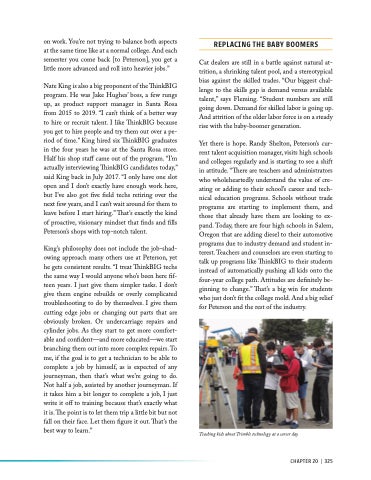
Teaching kids about Trimble technology at a career day
CHAPTER 20 | 325


