


Page 248 - Peterson 85 Years And Going Strong
P. 248
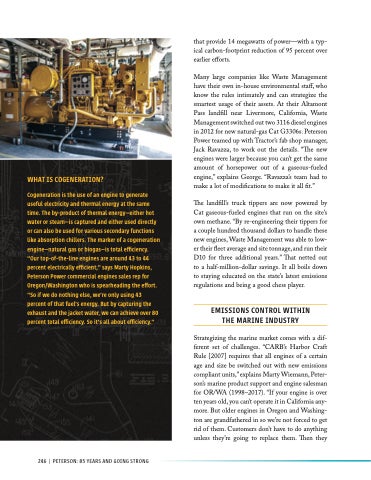
WHAT IS COGENERATION?
Cogeneration is the use of an engine to generate
useful electricity and thermal energy at the same
time. The by-product of thermal energy—either hot
water or steam—is captured and either used directly
or can also be used for various secondary functions
like absorption chillers. The marker of a cogeneration
engine—natural gas or biogas—is total efficiency.
“Our top-of-the-line engines are around 43 to 44
percent electrically efficient,” says Marty Hopkins,
Peterson Power commercial engines sales rep for
Oregon/Washington who is spearheading the effort.
“So if we do nothing else, we’re only using 43
percent of that fuel’s energy. But by capturing the
exhaust and the jacket water, we can achieve over 80
percent total efficiency. So it’s all about efficiency.”
that provide 14 megawatts of power—with a typ-
ical carbon-footprint reduction of 95 percent over
earlier efforts.
Many large companies like Waste Management
have their own in-house environmental staff, who
know the rules intimately and can strategize the
smartest usage of their assets. At their Altamont
Pass landfill near Livermore, California, Waste
Management switched out two 3116 diesel engines
in 2012 for new natural-gas Cat G3306s. Peterson
Power teamed up with Tractor’s fab shop manager,
Jack Ravazza, to work out the details. “The new
engines were larger because you can’t get the same
amount of horsepower out of a gaseous-fueled
engine,” explains George. “Ravazza’s team had to
make a lot of modifications to make it all fit.”
The landfill’s truck tippers are now powered by
Cat gaseous-fueled engines that run on the site’s
own methane. “By re-engineering their tippers for
a couple hundred thousand dollars to handle these
new engines, Waste Management was able to low-
er their fleet average and site tonnage, and run their
D10 for three additional years.” That netted out
to a half-million-dollar savings. It all boils down
to staying educated on the state’s latest emissions
regulations and being a good chess player.
EMISSIONS CONTROL WITHIN
THE MARINE INDUSTRY
Strategizing the marine market comes with a dif-
ferent set of challenges. “CARB’s Harbor Craft
Rule [2007] requires that all engines of a certain
age and size be switched out with new emissions
compliant units,” explains Marty Wiemann, Peter-
son’s marine product support and engine salesman
for OR/WA (1998–2017). “If your engine is over
ten years old, you can’t operate it in California any-
more. But older engines in Oregon and Washing-
ton are grandfathered in so we’re not forced to get
rid of them. Customers don’t have to do anything
unless they’re going to replace them. Then they
246 | PETERSON: 85 YEARS AND GOING STRONG


