


Page 214 - Peterson 85 Years And Going Strong
P. 214
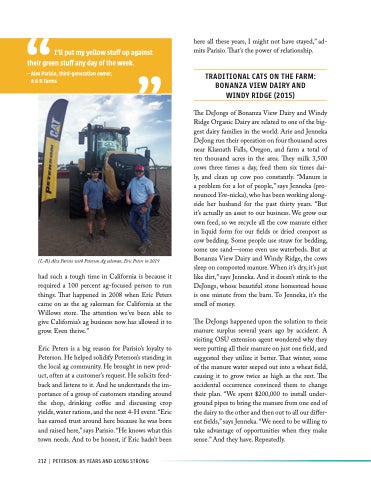
I’ll put my yellow stuff up against
their green stuff any day of the week.
–  Alex Parisio, third-generation owner,
A & R Farms
(L-R) Alex Parisio with Peterson Ag saleman, Eric Peters in 2019
had such a tough time in California is because it
required a 100 percent ag-focused person to run
things. That happened in 2008 when Eric Peters
came on as the ag salesman for California at the
Willows store. The attention we’ve been able to
give California’s ag business now has allowed it to
grow. Even thrive.”
Eric Peters is a big reason for Parisio’s loyalty to
Peterson. He helped solidify Peterson’s standing in
the local ag community. He brought in new prod-
uct, often at a customer’s request. He solicits feed-
back and listens to it. And he understands the im-
portance of a group of customers standing around
the shop, drinking coffee and discussing crop
yields, water rations, and the next 4-H event. “Eric
has earned trust around here because he was born
and raised here,” says Parisio. “He knows what this
town needs. And to be honest, if Eric hadn’t been
212 | PETERSON: 85 YEARS AND GOING STRONG
here all these years, I might not have stayed,” ad-
mits Parisio. That’s the power of relationship.
TRADITIONAL CATS ON THE FARM:
BONANZA VIEW DAIRY AND
WINDY RIDGE (2015)
The DeJongs of Bonanza View Dairy and Windy
Ridge Organic Dairy are related to one of the big-
gest dairy families in the world. Arie and Jenneka
DeJong run their operation on four thousand acres
near Klamath Falls, Oregon, and farm a total of
ten thousand acres in the area. They milk 3,500
cows three times a day, feed them six times dai-
ly, and clean up cow poo constantly. “Manure is
a problem for a lot of people,” says Jenneka (pro-
nounced Yen-nicka), who has been working along-
side her husband for the past thirty years. “But
it’s actually an asset to our business. We grow our
own feed, so we recycle all the cow manure either
in liquid form for our fields or dried compost as
cow bedding. Some people use straw for bedding,
some use sand—some even use waterbeds. But at
Bonanza View Dairy and Windy Ridge, the cows
sleep on composted manure. When it’s dry, it’s just
like dirt,” says Jenneka. And it doesn’t stink to the
DeJongs, whose beautiful stone homestead house
is one minute from the barn. To Jenneka, it’s the
smell of money.
The DeJongs happened upon the solution to their
manure surplus several years ago by accident. A
visiting OSU extension agent wondered why they
were putting all their manure on just one field, and
suggested they utilize it better. That winter, some
of the manure water seeped out into a wheat field,
causing it to grow twice as high as the rest. The
accidental occurrence convinced them to change
their plan. “We spent $200,000 to install under-
ground pipes to bring the manure from one end of
the dairy to the other and then out to all our differ-
ent fields,” says Jenneka. “We need to be willing to
take advantage of opportunities when they make
sense.” And they have. Repeatedly.


