


Page 212 - Peterson 85 Years And Going Strong
P. 212
precisely how Parker acquired half of the land he
farms today, all within a twenty-mile radius.
Diversification has also been a critical factor to the
Parkers’ success. “You have to diversify to make it,”
says Parker. “The weather is a huge part of the grass
seed business. Last year [2015] it didn’t rain from
April until harvest, so we got a poor crop. It just all
dried up. That’s why you plant different varieties of
grass.” Today, the Parkers vary their crops between
annual ryegrass, wheat, clover, and different types
of fescue grass seed. “We clean ten to twelve mil-
lion pounds of grass seed a year. We do everything
but plant the seed for the buyer.” Their grass seed
is used across the US and overseas in China and
Australia. They also bale off the grass straw for ex-
port to Japan and South Korea. Nothing is wasted.
The Parkers use a lot of big equipment to do all
that. “Before Peterson moved in, we were green as
green could be. But things have changed. Nowa-
days you see a lot of AGCO tractors around. Be-
fore it was John Deere, but they just got too expen-
sive.” Today, Parker runs combines, swathers, and
Challenger tractors—all Claas and AGCO prod-
ucts sold by Peterson. “I’m on my seventh, eighth,
and ninth Claas combines now,” says Parker. “They
just work better in grass seed. I was running four
Claas 670 walker machines, but this year [2015]
I went to three new rotary 760 Claas combines.
They’re bigger, they’re faster, and we get the same
amount done with one less machine.”
His rotary 760 was also the first in the Willamette
Valley. “Spencer [Whitlow, Peterson ag salesman]
spent a lot of time out here babysitting that com-
bine because there’s so many different settings to
deal with. And if it didn’t work right, well . . . word-
of-mouth spreads fast in the valley.” Fortunately,
it worked great. Since then, Parker has been the
poster child for the rotary combine in the South
Valley. Several others have followed his lead.
CALIFORNIA RICE: A & R FARMS (2015)
Rice is king in the Sacramento Valley and the Pari-
sios are one of the oldest rice families in the valley.
Their patriarch, Ted Parisio, bought 640 acres near
Willows in 1946, but it wasn’t until 1982 that they
became Peterson customers. “I remember going
into Zumwalt picking up parts as a kid,” says Alex
Parisio, who now farms with his dad, Ron, as A &
R Farms. “They had a popcorn machine and soda
machine in the lobby. That’s why I went.” Alex and
his dad still have the two D6Ds they bought in the
early 1980s, one with a Zumwalt sticker on it, the
other with a Peterson sticker—perfect bookends
of the transition.
Three generations of Parisios have witnessed the
evolution of the rice industry, from horse-drawn
combines to the Challengers and Lexion harvest-
ers of today. “Back in the 1940s, my grandpa used
a horse-drawn harvester that took a crew of twenty
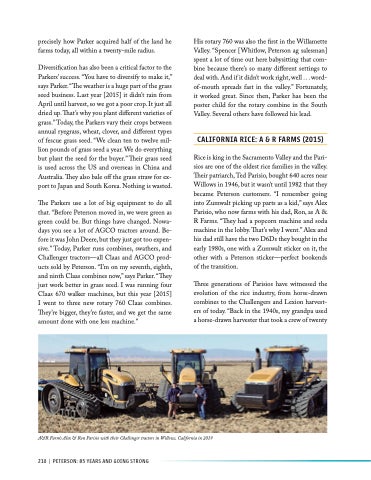
A&R Farm’s Alex & Ron Parisio with their Challenger tractors in Willows, California in 2019
210 | PETERSON: 85 YEARS AND GOING STRONG


