


Page 203 - Peterson 85 Years And Going Strong
P. 203
We do what we say
Looking back, he sometimes wonders why he bought that Timberking given all the issues that surfaced on the
initial two-week demo. Or why he’d stuck it out for the long haul. “For me, it all boils down to Mike Coiner,
our support guy. And Deon Meyers who sold us that first Timberking. When I bought it, Mike told me they’d
do everything they possibly could to support me. And they did. They bent over backwards to help us out. They
never left us hanging. They were there when we needed them.”
In those early weeks and months, several issues floated to the surface. Some were easy to fix. Others were
not. Out of the six customers that demo-ed the machine, only TRM bought one. For increasingly painful
reasons, Peterson decided to park their other Timberkings out back
until things changed. By summer 2006, things had come to a head.
In August, top Peterson management called a meeting with key Cat
personnel to discuss the Timberking. It was a frank and vocal meeting,
posing the basic question: “Why are you still making these machines
with all these known problems?”
That first Timberking—the TK700 series—came with a Caterpillar
engine, plumbed with Parker hydraulics and electronics. Therein lay
much of the problem. The engine’s computer couldn’t talk to Parker’s
hydraulics software. And vice-versa. Instead, they impeded each other,
severely restricting the output. “We could still get the same production
out of the Timberking that we did with both our older Timbcos com-
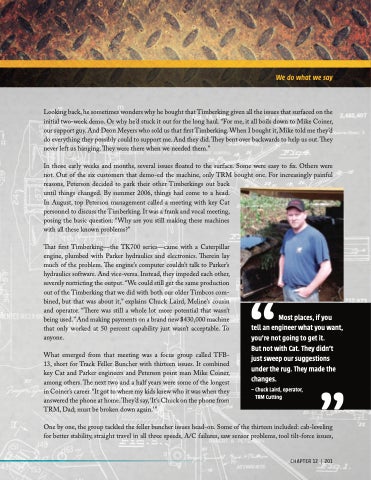
bined, but that was about it,” explains Chuck Laird, Meline’s cousin
and operator. “There was still a whole lot more potential that wasn’t
being used.” And making payments on a brand new $430,000 machine
that only worked at 50 percent capability just wasn’t acceptable. To
anyone.
What emerged from that meeting was a focus group called TFB-
13, short for Track Feller Buncher with thirteen issues. It combined
key Cat and Parker engineers and Peterson point man Mike Coiner,
among others. The next two and a half years were some of the longest
in Coiner’s career. “It got to where my kids knew who it was when they
answered the phone at home. They’d say, ‘It’s Chuck on the phone from
TRM, Dad; must be broken down again.’ ”
One by one, the group tackled the feller buncher issues head-on. Some of the thirteen included: cab-leveling
for better stability, straight travel in all three speeds, A/C failures, saw sensor problems, tool tilt-force issues,
Most places, if you
tell an engineer what you want,
you’re not going to get it.
But not with Cat. They didn’t
just sweep our suggestions
under the rug. They made the
changes.
–  Chuck Laird, operator,
TRM Cutting
CHAPTER 12 | 201


