


Page 197 - Peterson 85 Years And Going Strong
P. 197
•
•
design and build a new electrical harness
fabricate 1500 pieces to make everything fit
properly.
“The whole project was a huge undertaking,” says
Stickney, who has spent half his 33-year career as
an ace field tech. “We had some minor changes
along the way, but for the most part, we ended up
with what we had originally planned. We put a lot
of thought into it and hashed out a lot of details
beforehand. What we came up with was a really
good platform.”
Building the prototype was all about finding, or
making, the right parts and fitting them into a
huge jigsaw puzzle that would ultimately look like
it came out of the factory. “We had that engine in
and out many times before we got it right,” says
Carl Clarke, the project lead on the shop floor
for the prototype and first two production ma-
chines. “I found different Cat parts I could get
to fit off of other machines. It could be any ma-
chine running a C7 engine. I pulled parts off a 525
skidder—hoses for the radiator, turbo hoses, and
all the different clamps, electrical relays, A/C con-
figurations, and accumulators—so we wouldn’t
have to use after-market parts. We wanted to min-
imize what we fabricated to make parts ordering
easier.” Clarke worked extensively with Stickney,
who has been doing repowers and upgrades since
the early 2000s. “At one point, Cat had their reps
there watching us, surprised at what we were do-
ing. I really wanted to see this succeed because the
527 is my all-time favorite machine. It’s something
I grew up with. It’s the most beat up machine in
the woods. It’s a mean-looking, bad-ass machine.”
TRACTOR IN A BOX
The prototype took eight months to complete.
Once it was finished, welder Pat Good joined the
team. “Carl built the first one, then tore it apart to
document everything so we could make patterns
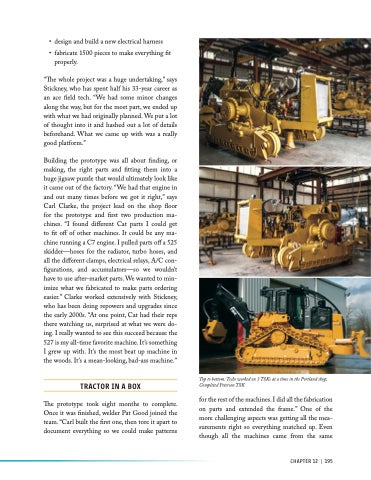
Top to bottom: Techs worked on 3 TSKs at a time in the Portland shop;
Completed Peterson TSK
for the rest of the machines. I did all the fabrication
on parts and extended the frame.” One of the
more challenging aspects was getting all the mea-
surements right so everything matched up. Even
though all the machines came from the same
CHAPTER 12 | 195


