


Page 195 - Peterson 85 Years And Going Strong
P. 195
frame, with its center of gravity moved forward for
better balance. By the time Cat quit building them,
they were on an obsolete platform but still quite
popular in the woods. If fact, 527s are considered
so priceless and indispensable by some, that one
customer still keeps his going by sheer will and
bungee cords.
In 2010, Caterpillar stopped importing 527 skid-
ders into North America due to the EPA’s new
emissions requirements. A number of other Cat
models had already been discontinued for the
same reason: too much R&D for too little return.
Since North American dealers only sold about 24
units a year, the 527 didn’t make the cut. However,
Cat continued to build the 527 at its factory in
Indonesia for an international market that wasn’t
regulated by the EPA.
Loggers are data-driven environmen-
talists. We are the true environmentalists.
– Larsen Arndt, D & S Logging
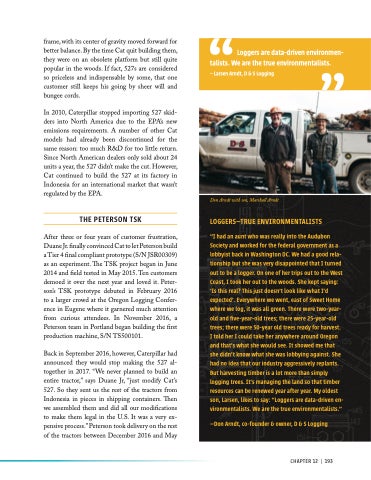
Don Arndt with son, Marshall Arndt
THE PETERSON TSK
After three or four years of customer frustration,
Duane Jr. finally convinced Cat to let Peterson build
a Tier 4 final compliant prototype (S/N JSR00309)
as an experiment. The TSK project began in June
2014 and field tested in May 2015. Ten customers
demoed it over the next year and loved it. Peter-
son’s TSK prototype debuted in February 2016
to a larger crowd at the Oregon Logging Confer-
ence in Eugene where it garnered much attention
from curious attendees. In November 2016, a
Peterson team in Portland began building the first
production machine, S/N TS500101.
Back in September 2016, however, Caterpillar had
announced they would stop making the 527 al-
together in 2017. “We never planned to build an
entire tractor,” says Duane Jr, “just modify Cat’s
527. So they sent us the rest of the tractors from
Indonesia in pieces in shipping containers. Then
we assembled them and did all our modifications
to make them legal in the U.S. It was a very ex-
pensive process.” Peterson took delivery on the rest
of the tractors between December 2016 and May
LOGGERS—TRUE ENVIRONMENTALISTS
“I had an aunt who was really into the Audubon
Society and worked for the federal government as a
lobbyist back in Washington DC. We had a good rela-
tionship but she was very disappointed that I turned
out to be a logger. On one of her trips out to the West
Coast, I took her out to the woods. She kept saying:
‘Is this real? This just doesn’t look like what I’d
expected’. Everywhere we went, east of Sweet Home
where we log, it was all green. There were two-year-
old and five-year-old trees; there were 25-year-old
trees; there were 50-year old trees ready for harvest.
I told her I could take her anywhere around Oregon
and that’s what she would see. It showed me that
she didn’t know what she was lobbying against. She
had no idea that our industry aggressively replants.
But harvesting timber is a lot more than simply
logging trees. It’s managing the land so that timber
resources can be renewed year after year. My oldest
son, Larsen, likes to say: “Loggers are data-driven en-
vironmentalists. We are the true environmentalists.”
—Don Arndt, co-founder & owner, D & S Logging
CHAPTER 12 | 193


