


Page 190 - Peterson 85 Years And Going Strong
P. 190
“That’s how I got my loader,” says Leonardo, who
today, runs a fleet of seven Cat loaders, five Cat
dozers, one Peterson TSK, five Cat excavators, two
Cat 525 skidders, two Thunderbird yarders and
sixteen trucks. “I’ve been with Peterson ever since.”
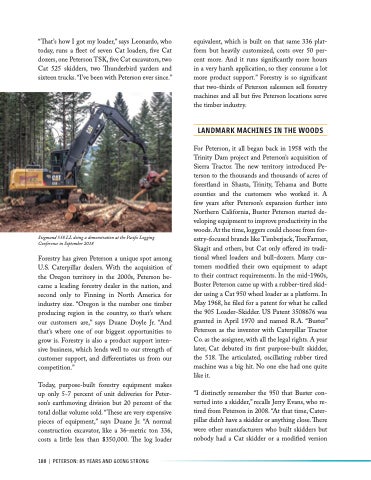
Siegmund 558 LL doing a demonstration at the Pacific Logging
Conference in September 2018
Forestry has given Peterson a unique spot among
U.S. Caterpillar dealers. With the acquisition of
the Oregon territory in the 2000s, Peterson be-
came a leading forestry dealer in the nation, and
second only to Finning in North America for
industry size. “Oregon is the number one timber
producing region in the country, so that’s where
our customers are,” says Duane Doyle Jr. “And
that’s where one of our biggest opportunities to
grow is. Forestry is also a product support inten-
sive business, which lends well to our strength of
customer support, and differentiates us from our
competition.”
Today, purpose-built forestry equipment makes
up only 5-7 percent of unit deliveries for Peter-
son’s earthmoving division but 20 percent of the
total dollar volume sold. “These are very expensive
pieces of equipment,” says Duane Jr. “A normal
construction excavator, like a 36-metric ton 336,
costs a little less than $350,000. The log loader
188 | PETERSON: 85 YEARS AND GOING STRONG
equivalent, which is built on that same 336 plat-
form but heavily customized, costs over 50 per-
cent more. And it runs significantly more hours
in a very harsh application, so they consume a lot
more product support.” Forestry is so significant
that two-thirds of Peterson salesmen sell forestry
machines and all but five Peterson locations serve
the timber industry.
LANDMARK MACHINES IN THE WOODS
For Peterson, it all began back in 1958 with the
Trinity Dam project and Peterson’s acquisition of
Sierra Tractor. The new territory introduced Pe-
terson to the thousands and thousands of acres of
forestland in Shasta, Trinity, Tehama and Butte
counties and the customers who worked it. A
few years after Peterson’s expansion further into
Northern California, Buster Peterson started de-
veloping equipment to improve productivity in the
woods. At the time, loggers could choose from for-
estry-focused brands like Timberjack, TreeFarmer,
Skagit and others, but Cat only offered its tradi-
tional wheel loaders and bull-dozers. Many cus-
tomers modified their own equipment to adapt
to their contract requirements. In the mid-1960s,
Buster Peterson came up with a rubber-tired skid-
der using a Cat 950 wheel loader as a platform. In
May 1968, he filed for a patent for what he called
the 905 Loader-Skidder. US Patent 3508676 was
granted in April 1970 and named R.A. “Buster”
Peterson as the inventor with Caterpillar Tractor
Co. as the assignee, with all the legal rights. A year
later, Cat debuted its first purpose-built skidder,
the 518. The articulated, oscillating rubber tired
machine was a big hit. No one else had one quite
like it.
“I distinctly remember the 950 that Buster con-
verted into a skidder,” recalls Jerry Evans, who re-
tired from Peterson in 2008. “At that time, Cater-
pillar didn’t have a skidder or anything close. There
were other manufacturers who built skidders but
nobody had a Cat skidder or a modified version


