


Page 178 - Peterson 85 Years And Going Strong
P. 178
That Tracy job was the turning point for Poppoff.
“The next day, I discussed it with my boss and
then went down to Peterson to meet with Der-
ek [Pasut, Peterson salesman at the time]. We sat
down and ordered a paver and got delivery from
the factory three weeks later. That Cat paver paved
everything on I-580 from Vernalis all the way to
the Altamont in the summer of 2016. That was a
$100-million job and it performed flawlessly. It
never broke down and it’s still out there.”
PAVING BENCHMARKS
The biggest change in paving equipment over the
last twenty years came with the rubber track con-
cept. That’s when paving really took off, according
to Marty Johnson, who has worked on every type
of paver out there, over his three-decade career.
“Cat was the first to use the rubber track design.
Before that, there were two kinds of pavers. One
had a steel undercarriage and rubber pads so you
could run on the street. Their advantage was trac-
tive effort, better flotation, and it could push trucks
easier. The other was the rubber-tired paver that
had less wear and tear, ran cheaper, and had bet-
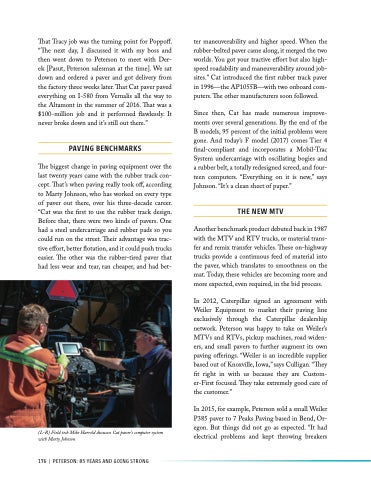
(L-R) Field tech Mike Harreld discusses Cat paver’s computer system
with Marty Johnson
176 | PETERSON: 85 YEARS AND GOING STRONG
ter maneuverability and higher speed. When the
rubber-belted paver came along, it merged the two
worlds. You got your tractive effort but also high-
speed roadability and maneuverability around job-
sites.” Cat introduced the first rubber track paver
in 1996—the AP1055B—with two onboard com-
puters. The other manufacturers soon followed.
Since then, Cat has made numerous improve-
ments over several generations. By the end of the
B models, 95 percent of the initial problems were
gone. And today’s F model (2017) comes Tier 4
final-compliant and incorporates a Mobil-Trac
System undercarriage with oscillating bogies and
a rubber belt, a totally redesigned screed, and four-
teen computers. “Everything on it is new,” says
Johnson. “It’s a clean sheet of paper.”
THE NEW MTV
Another benchmark product debuted back in 1987
with the MTV and RTV trucks, or material trans-
fer and remix transfer vehicles. These on-highway
trucks provide a continuous feed of material into
the paver, which translates to smoothness on the
mat. Today, these vehicles are becoming more and
more expected, even required, in the bid process.
In 2012, Caterpillar signed an agreement with
Weiler Equipment to market their paving line
exclusively through the Caterpillar dealership
network. Peterson was happy to take on Weiler’s
MTVs and RTVs, pickup machines, road widen-
ers, and small pavers to further augment its own
paving offerings. “Weiler is an incredible supplier
based out of Knoxville, Iowa,” says Culligan. “They
fit right in with us because they are Custom-
er-First focused. They take extremely good care of
the customer.”
In 2015, for example, Peterson sold a small Weiler
P385 paver to 7 Peaks Paving based in Bend, Or-
egon. But things did not go as expected. “It had
electrical problems and kept throwing breakers


