


Page 161 - Peterson 85 Years And Going Strong
P. 161
ROUND TWO: CAT GOES SOLO (2015)
In June 2015, Caterpillar announced it would build
its own truck—an all-Cat version—at a state-of-
the-art facility in Texas. “That’s how we’re going to
get our customers back,” said Ken Ehni in April
2015, as Power’s parts general manager. The official
announcement came with a delivery commitment
of the second quarter of 2016. That left just one
question. Would there be a Cat truck engine under
the hood in the future?
Less than six months later, the answer came back
with a resounding no. On February 26, 2016, Cat-
erpillar announced they were pulling out of the
truck industry altogether—engines, trucks, the
works. The EPA’s stringent and costly measures
had struck the final blow. “Remaining a viable
competitor in the market would require significant
additional investment to develop and launch a
complete portfolio of trucks,” said Ramin Younes-
si, VP of Cat’s Industrial Power Systems Division.
Upon further review, they decided there just wasn’t
a sufficient market opportunity to justify further
investment. They would, however, continue to of-
fer customer support for the trucks already on the
road. That meant Cat dealers would continue of-
fering the same product support as before to their
on-highway truck customers for the Cat trucks
that had been sold. But the CT660, CT680, and
CT681 would cease production immediately. Cus-
tomer hopes for an all-Cat truck were put to bed
for good.
SUPPORTING CAT ENGINES:
PAST PRIME TIME
Peterson was selling 1,500 Cat truck engines a year
when Caterpillar shut down its Mossville engine
factory in 2008. And with 52 percent of the mar-
ket, that left only 48 percent to split between the
rest of the equipment manufacturers—Cummins,
Detroit Diesel, International, MACK, and Volvo.
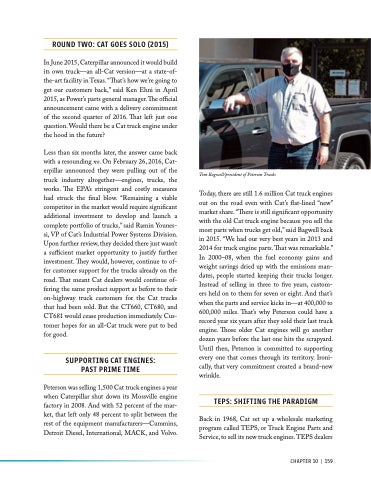
Tom Bagwell/president of Peterson Trucks
Today, there are still 1.6 million Cat truck engines
out on the road even with Cat’s flat-lined “new”
market share. “There is still significant opportunity
with the old Cat truck engine because you sell the
most parts when trucks get old,” said Bagwell back
in 2015. “We had our very best years in 2013 and
2014 for truck engine parts. That was remarkable.”
In 2000–08, when the fuel economy gains and
weight savings dried up with the emissions man-
dates, people started keeping their trucks longer.
Instead of selling in three to five years, custom-
ers held on to them for seven or eight. And that’s
when the parts and service kicks in—at 400,000 to
600,000 miles. That’s why Peterson could have a
record year six years after they sold their last truck
engine. Those older Cat engines will go another
dozen years before the last one hits the scrapyard.
Until then, Peterson is committed to supporting
every one that comes through its territory. Ironi-
cally, that very commitment created a brand-new
wrinkle.
TEPS: SHIFTING THE PARADIGM
Back in 1968, Cat set up a wholesale marketing
program called TEPS, or Truck Engine Parts and
Service, to sell its new truck engines. TEPS dealers
CHAPTER 10 | 159


