


Page 149 - Peterson 85 Years And Going Strong
P. 149
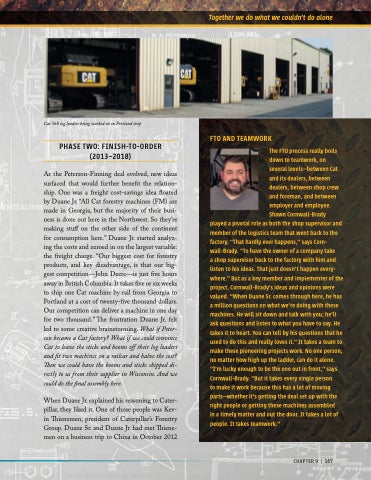
Cat 568 log loaders being worked on in Portland shop
PHASE TWO: FINISH-TO-ORDER
(2013–2018)
As the Peterson-Finning deal evolved, new ideas
surfaced that would further benefit the relation-
ship. One was a freight cost-savings idea floated
by Duane Jr. “All Cat forestry machines (FM) are
made in Georgia, but the majority of their busi-
ness is done out here in the Northwest. So they’re
making stuff on the other side of the continent
for consumption here.” Duane Jr. started analyz-
ing the costs and zeroed in on the largest variable:
the freight charge. “Our biggest cost for forestry
products, and key disadvantage, is that our big-
gest competition—John Deere—is just five hours
away in British Columbia. It takes five or six weeks
to ship one Cat machine by rail from Georgia to
Portland at a cost of twenty-five thousand dollars.
Our competition can deliver a machine in one day
for two thousand.” The frustration Duane Jr. felt
led to some creative brainstorming. What if Peter-
son became a Cat factory? What if we could convince
Cat to leave the sticks and booms off their log loaders
and fit two machines on a railcar and halve the cost?
Then we could have the booms and sticks shipped di-
rectly to us from their supplier in Wisconsin. And we
could do the final assembly here.
When Duane Jr. explained his reasoning to Cater-
pillar, they liked it. One of those people was Kev-
in Thienemen, president of Caterpillar’s Forestry
Group. Duane Sr. and Duane Jr. had met Thiene-
men on a business trip to China in October 2012
Together we do what we couldn’t do alone
FTO AND TEAMWORK
The FTO process really boils
down to teamwork, on
several levels—between Cat
and its dealers, between
dealers, between shop crew
and foreman, and between
employer and employee.
Shawn Cornwall-Brady
played a pivotal role as both the shop supervisor and
member of the logistics team that went back to the
factory. “That hardly ever happens,” says Corn-
wall-Brady. “To have the owner of a company take
a shop supervisor back to the factory with him and
listen to his ideas. That just doesn’t happen every-
where.” But as a key member and implementer of the
project, Cornwall-Brady’s ideas and opinions were
valued. “When Duane Sr. comes through here, he has
a million questions on what we’re doing with these
machines. He will sit down and talk with you; he’ll
ask questions and listen to what you have to say. He
takes it to heart. You can tell by his questions that he
used to do this and really loves it.” It takes a team to
make these pioneering projects work. No one person,
no matter how high up the ladder, can do it alone.
“I’m lucky enough to be the one out in front,” says
Cornwall-Brady. “But it takes every single person
to make it work because this has a lot of moving
parts—whether it’s getting the deal set up with the
right people or getting these machines assembled
in a timely matter and out the door. It takes a lot of
people. It takes teamwork.”
CHAPTER 9 | 147


