


Page 127 - Peterson 85 Years And Going Strong
P. 127
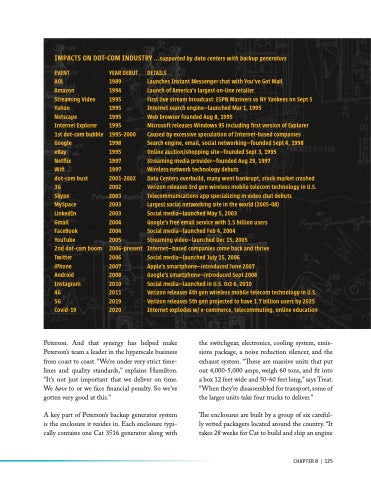
IMPACTS ON DOT-COM INDUSTRY ...supported by data centers with backup generators
EVENT YEAR DEBUT DETAILS
AOL 1989 Launches Instant Messenger chat with You’ve Got Mail
Amazon 1994 Launch of America’s largest on-line retailer
Streaming Video 1995 First live stream broadcast: ESPN Mariners vs NY Yankees on Sept 5
Yahoo 1995 Internet search engine—launched Mar 1, 1995
Netscape 1995 Web browser founded Aug 8, 1995
Internet Explorer 1995 Microsoft releases Windows 95 including first version of Explorer
1st dot-com bubble 1995-2000 Caused by excessive speculation of Internet-based companies
Google 1998 Search engine, email, social networking—founded Sept 4, 1998
eBay 1995 Online auction/shopping site—founded Sept 3, 1995
Netflix 1997 Streaming media provider—founded Aug 29, 1997
Wifi 1997 Wireless network technology debuts
dot-com bust 2001-2002 Data Centers overbuild, many went bankrupt, stock market crashed
3G 2002 Verizon releases 3rd gen wireless mobile telecom technology in U.S.
Skype 2003 Telecommunications app specializing in video chat debuts
MySpace 2003 Largest social networking site in the world (2005-08)
LinkedIn 2003 Social media—launched May 5, 2003
Gmail 2004 Google’s free email service with 1.5 billion users
FaceBook 2004 Social media—launched Feb 4, 2004
YouTube 2005 Streaming video—launched Dec 15, 2005
2nd dot-com boom 2006-present Internet—based companies come back and thrive
Twitter 2006 Social media—launched July 15, 2006
iPhone 2007 Apple’s smartphone—introduced June 2007
Android 2008 Google’s smartphone—introduced Sept 2008
Instagram 2010 Social media—launched in U.S. Oct 6, 2010
4G 2011 Verizon releases 4th gen wireless mobile telecom technology in U.S.
5G 2019 Verizon releases 5th gen projected to have 1.7 billion users by 2025
Covid-19 2020 Internet explodes w/ e-commerce, telecommuting, online education
Peterson. And that synergy has helped make
Peterson’s team a leader in the hyperscale business
from coast to coast. “We’re under very strict time-
lines and quality standards,” explains Hamilton.
“It’s not just important that we deliver on time.
We have to or we face financial penalty. So we’ve
gotten very good at this.”
A key part of Peterson’s backup generator system
is the enclosure it resides in. Each enclosure typi-
cally contains one Cat 3516 generator along with
the switchgear, electronics, cooling system, emis-
sions package, a noise reduction silencer, and the
exhaust system. “These are massive units that put
out 4,000-5,000 amps, weigh 60 tons, and fit into
a box 12 feet wide and 50-60 feet long,” says Treat.
“When they’re disassembled for transport, some of
the larger units take four trucks to deliver.”
The enclosures are built by a group of six careful-
ly vetted packagers located around the country. “It
takes 28 weeks for Cat to build and ship an engine
CHAPTER 8 | 125


