


Page 109 - Peterson 85 Years And Going Strong
P. 109
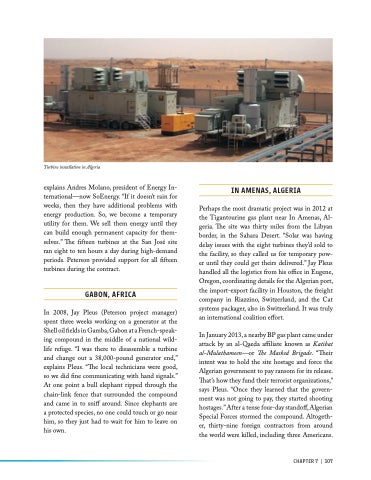
Turbine installation in Algeria
explains Andres Molano, president of Energy In-
ternational—now SoEnergy. “If it doesn’t rain for
weeks, then they have additional problems with
energy production. So, we become a temporary
utility for them. We sell them energy until they
can build enough permanent capacity for them-
selves.” The fifteen turbines at the San José site
ran eight to ten hours a day during high-demand
periods. Peterson provided support for all fifteen
turbines during the contract.
GABON, AFRICA
In 2008, Jay Pleus (Peterson project manager)
spent three weeks working on a generator at the
Shell oil fields in Gamba, Gabon at a French-speak-
ing compound in the middle of a national wild-
life refuge. “I was there to disassemble a turbine
and change out a 38,000-pound generator end,”
explains Pleus. “The local technicians were good,
so we did fine communicating with hand signals.”
At one point a bull elephant ripped through the
chain-link fence that surrounded the compound
and came in to sniff around. Since elephants are
a protected species, no one could touch or go near
him, so they just had to wait for him to leave on
his own.
IN AMENAS, ALGERIA
Perhaps the most dramatic project was in 2012 at
the Tigantourine gas plant near In Amenas, Al-
geria. The site was thirty miles from the Libyan
border, in the Sahara Desert. “Solar was having
delay issues with the eight turbines they’d sold to
the facility, so they called us for temporary pow-
er until they could get theirs delivered.” Jay Pleus
handled all the logistics from his office in Eugene,
Oregon, coordinating details for the Algerian port,
the import-export facility in Houston, the freight
company in Riazzino, Switzerland, and the Cat
systems packager, also in Switzerland. It was truly
an international coalition effort.
In January 2013, a nearby BP gas plant came under
attack by an al-Qaeda affiliate known as Katibat
al-Mulathameen—or The Masked Brigade. “Their
intent was to hold the site hostage and force the
Algerian government to pay ransom for its release.
That’s how they fund their terrorist organizations,”
says Pleus. “Once they learned that the govern-
ment was not going to pay, they started shooting
hostages.” After a tense four-day standoff, Algerian
Special Forces stormed the compound. Altogeth-
er, thirty-nine foreign contractors from around
the world were killed, including three Americans.
CHAPTER 7 | 107


